
Wedding planning runs on small decisions, and nails usually surface late. They appear in every photograph where hands are visible, which turns out to be most of them.
Bridal nail art has moved well past the plain French tip. The designs below range from quiet to detailed, and each one is a coordination decision as much as an aesthetic one. A manicure sits beside a gown fabric, a ring, a jewellery metal, and a bouquet. Those four things decide whether it looks considered or accidental.
What follows is twenty sophisticated bridal nail ideas, grouped by register. Alongside each group sits the practical question it raises: what it pairs with, what it competes with, and what it costs in chair time.
Why Your Bridal Manicure Deserves Real Planning
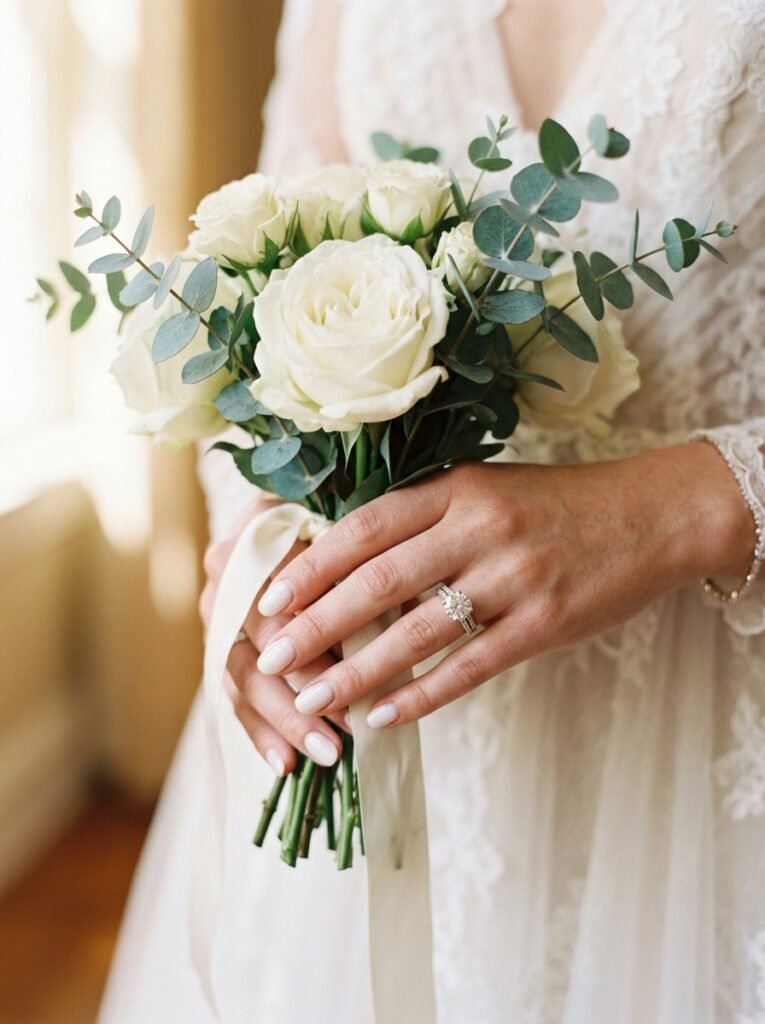
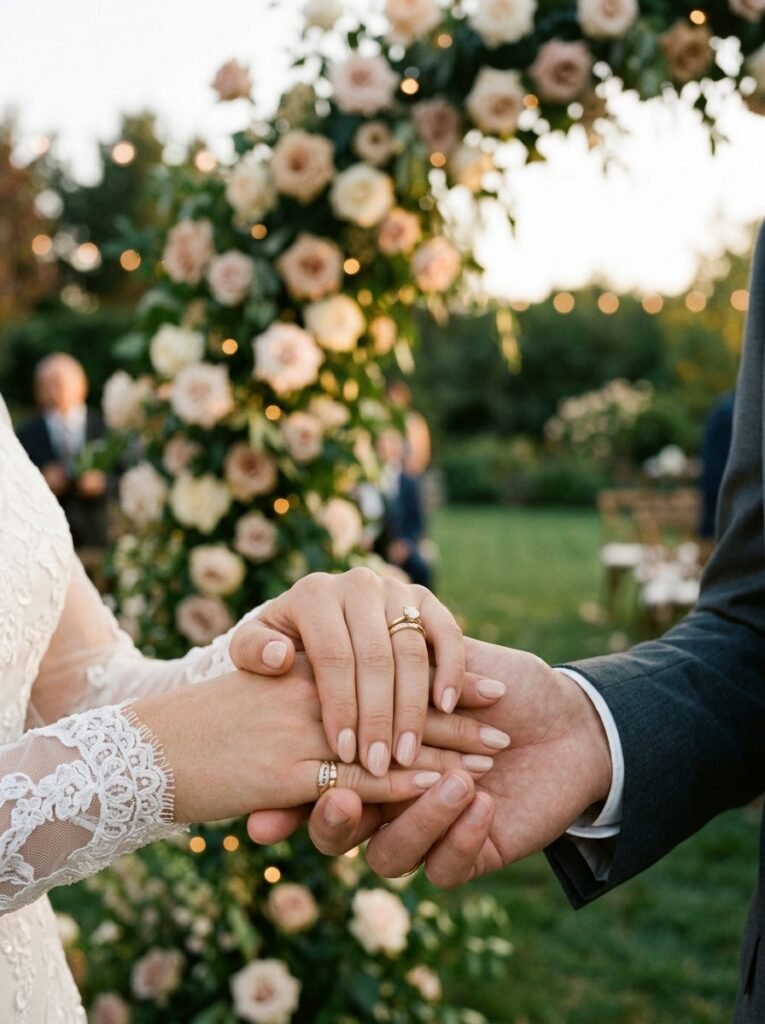
Close-up shots dominate a wedding gallery. Rings going on, hands clasped during vows, bouquet shots, and getting-ready frames all put hands at the shortest camera distance of the day.
The manicure also has a job to do. It faces hairspray, repeated hand-washing, a hundred handshakes, and often a flight the next morning. A design that photographs well but chips by the reception has failed at half its purpose.
The groups below are arranged by how much attention each design asks for. That makes it easier to match one to a gown rather than choosing in isolation.
Classic and Timeless Bridal Nail Designs
These four suit an ornate gown, because they add nothing that competes with it. They are also the safest choice alongside a detailed ring setting.
Classic French Manicure
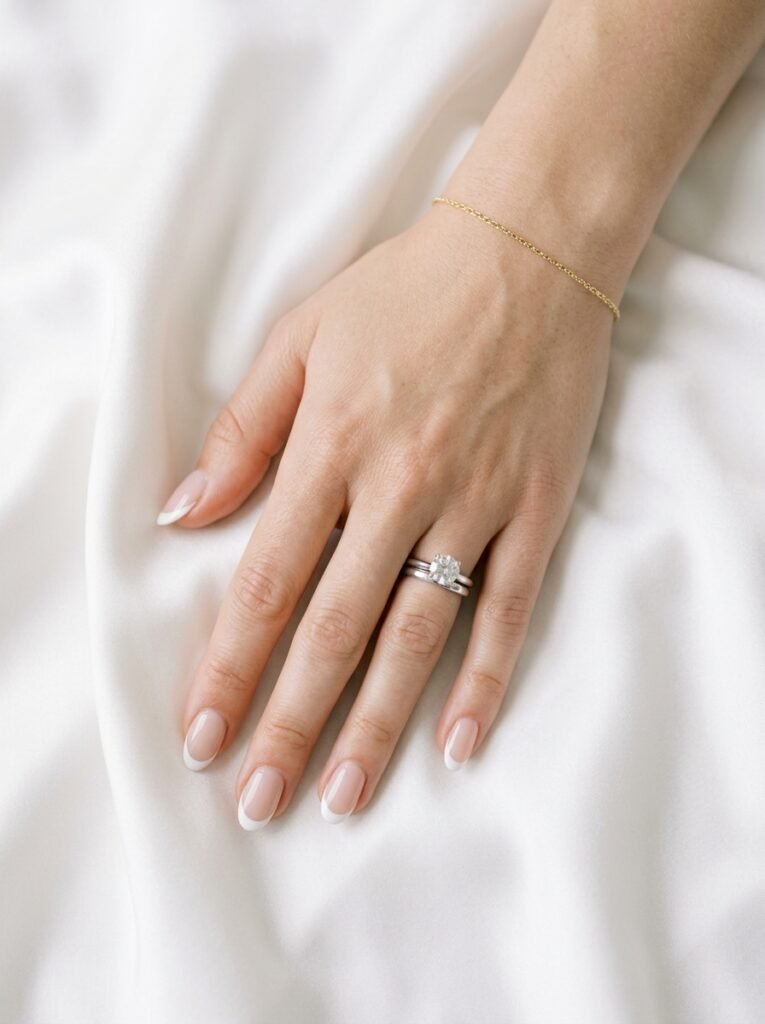
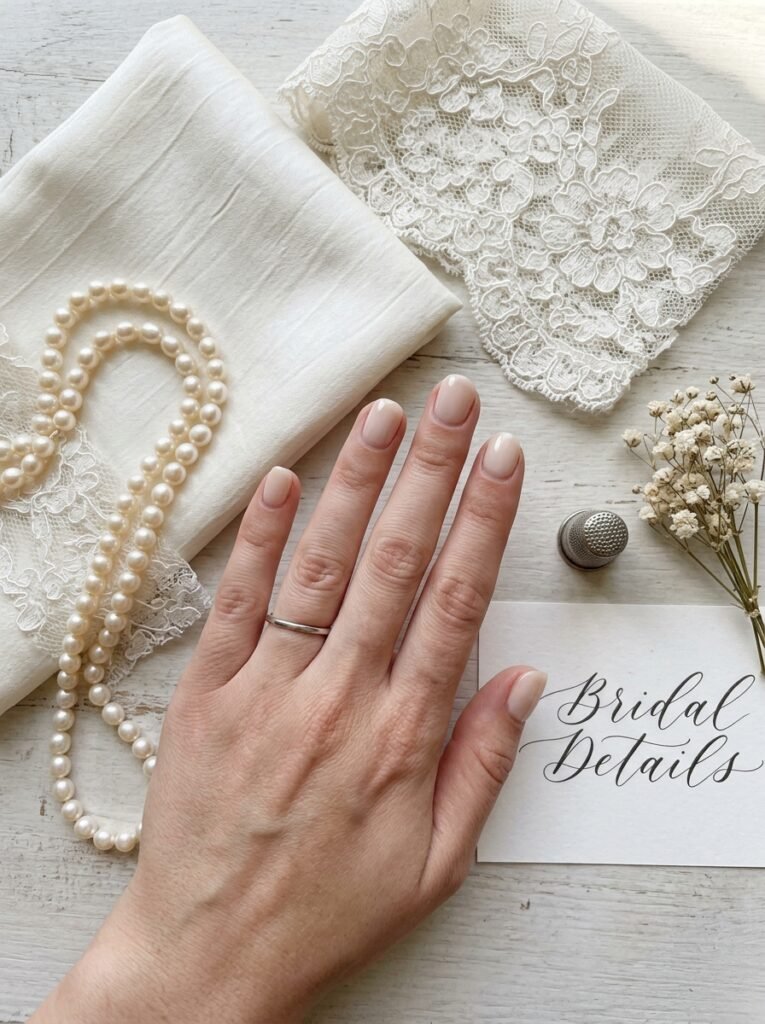
A white band over a sheer pink or nude base. Band width sets the mood: thin reads modern, thicker reads traditional.
It pairs with any dress and any metal, which is why it stays the most requested bridal set. The curve where white meets base is the flaw that shows first, so it is worth a daylight check before leaving the salon.
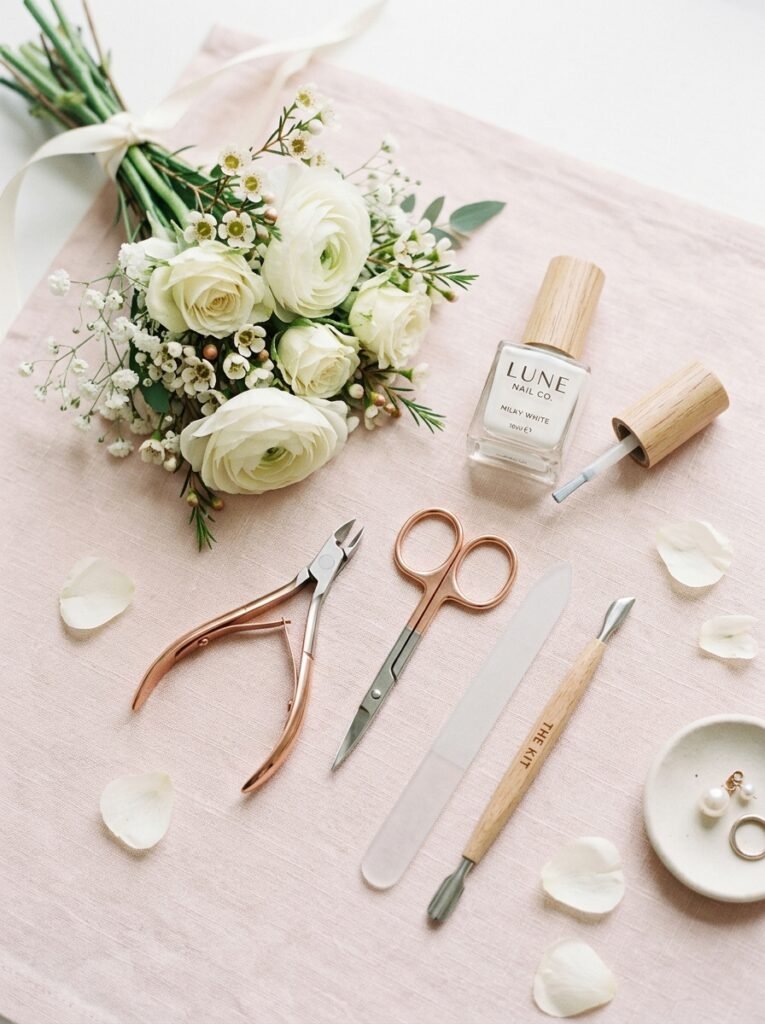
Milky White Nails
Semi-sheer white built across two or three thin coats, so the nail looks lit from beneath rather than painted over.
It suits ivory and champagne gowns better than a bright white does, since a stark white beside an ivory dress reads as a mismatch. Milky formulas magnify ridges in the nail plate, so a smoothing base coat matters here.
Soft Nude Manicure
Undertone decides this one, not shade name. Beige suits warm skin, blush suits cool, peach sits between.
Nude also hides a chip better than any other finish, which makes it the practical choice for a long day. It leaves the ring as the only thing drawing the eye in close-up frames.
Glass Nails
A chrome powder buffed over a sheer base produces the wet, glazed shine. This is gel-only work, since no regular polish reproduces it.
The finish reflects whatever light is available, so it changes character between an outdoor ceremony and an evening reception. That shift is the appeal, though it means the shade seen at the trial will not be the shade seen at dinner.
Delicate Detail Nail Designs for Brides
These four echo a gown rather than compete with it. Each works best on one or two accent nails, with the rest kept plain.
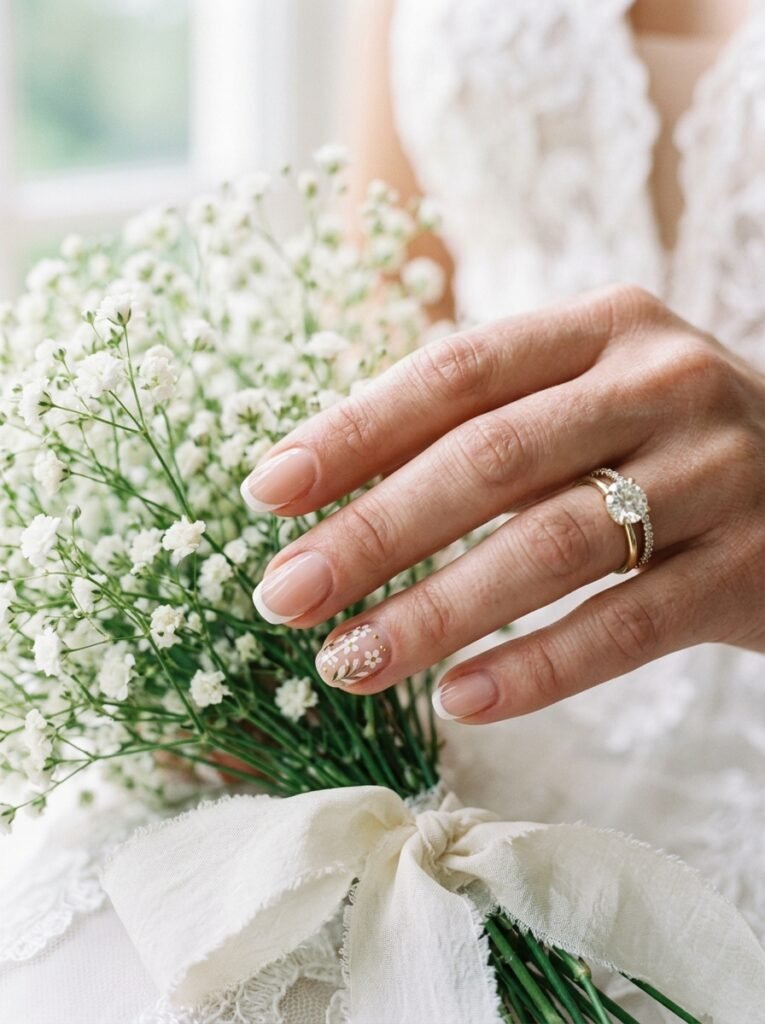
Fine Line French Tips
The tip reduces to a line barely a millimetre deep. Precision at that scale is difficult freehand, so this is one worth paying for.
It suits short nails particularly well, because the thin line does not shorten the apparent length the way a thick band does.
Micro Floral Accents
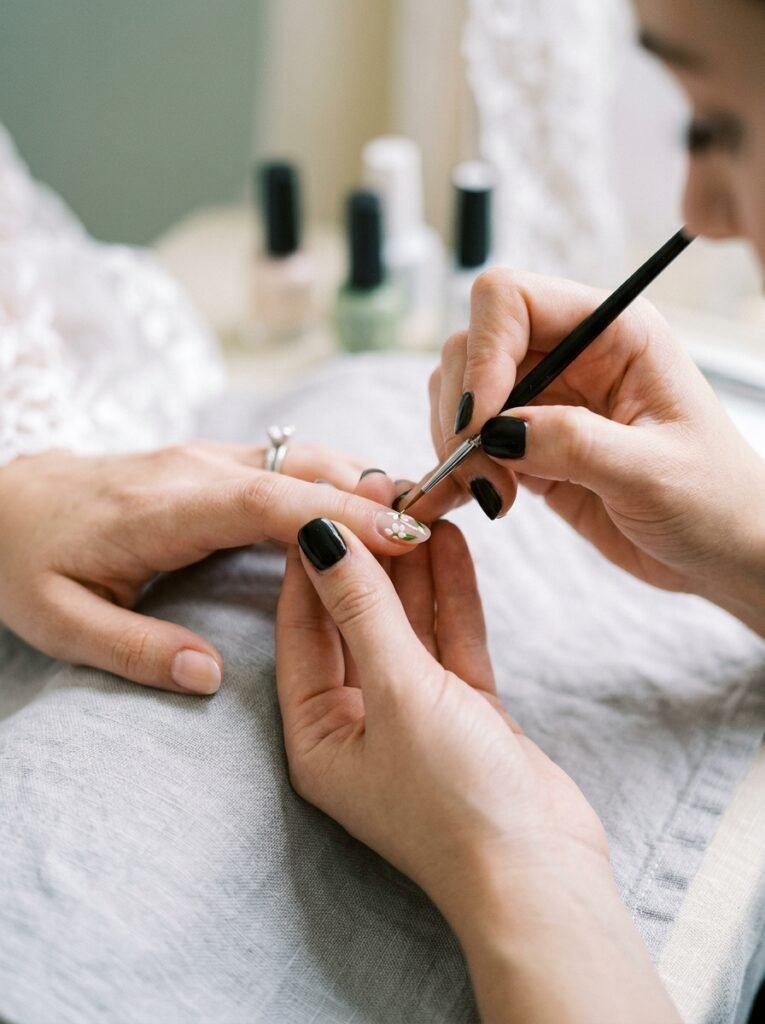
Tiny painted flowers on one or two nails. Hand-painted work is billed by time, so expect several times the cost of a decal.
Matching the flowers to the bouquet is the obvious move, and it needs coordinating with the florist rather than guessed at. Bringing a stem or a photograph to the appointment settles the shade.
Pearl Embellished Tips
Small pearls placed at the cuticle or tip of an accent nail. Half-pearls hold better than full spheres, and setting them into gel beats gluing onto a cured surface.
Pearl tones vary more than people expect, so a bride wearing inherited pearl jewellery should bring a piece to the appointment. Placement near the cuticle also keeps them clear of knocks and of catching on a beaded gown.
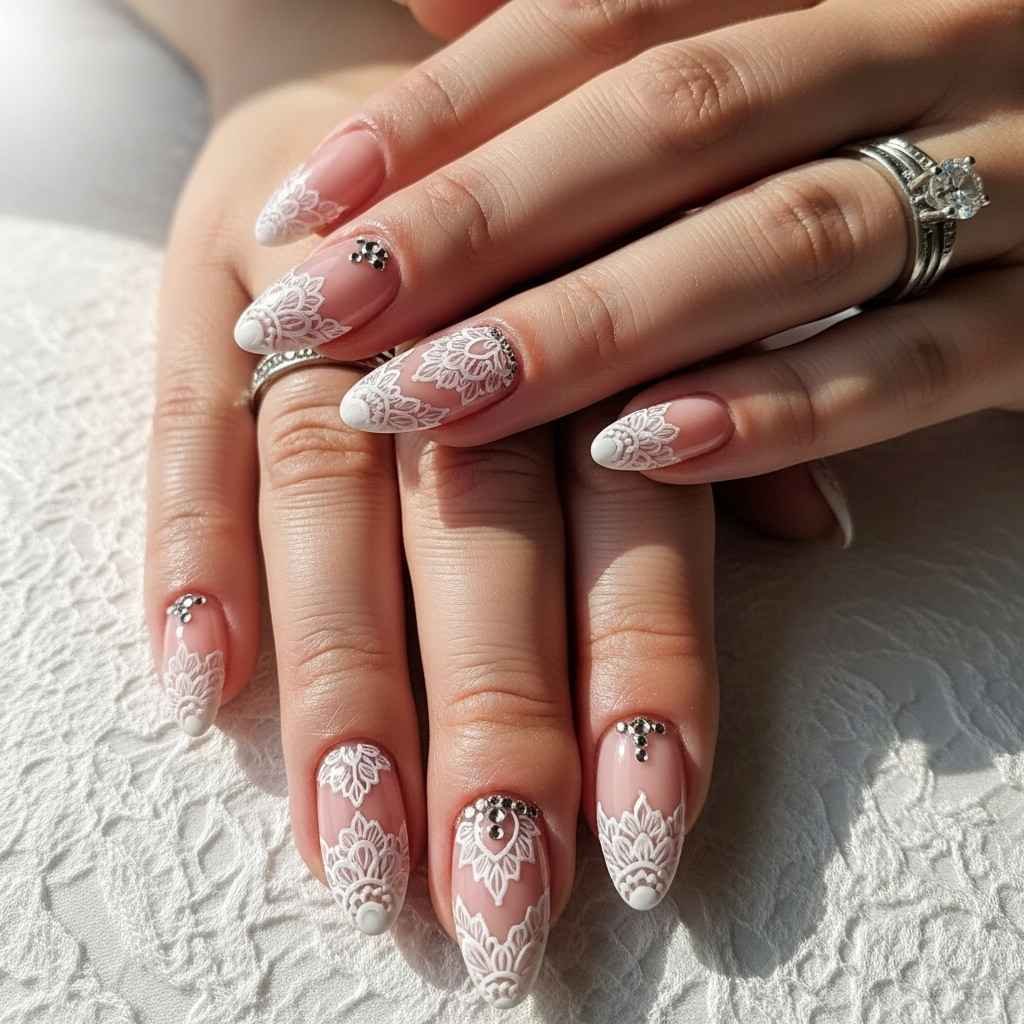
Delicate Lace Overlay
A fine lace pattern painted over a sheer base. Stamping plates give cleaner repeats and cost less; freehand work matches an actual gown pattern far more closely.
Anyone wanting the second version should bring a photograph of the dress fabric. The detail also needs medium-length nails, since a very short nail leaves little canvas.
Romantic and Feminine Bridal Nail Ideas
This group introduces colour, which raises a coordination question the neutrals avoid. Pink beside a bouquet in a different pink is the most common clash on a wedding day.
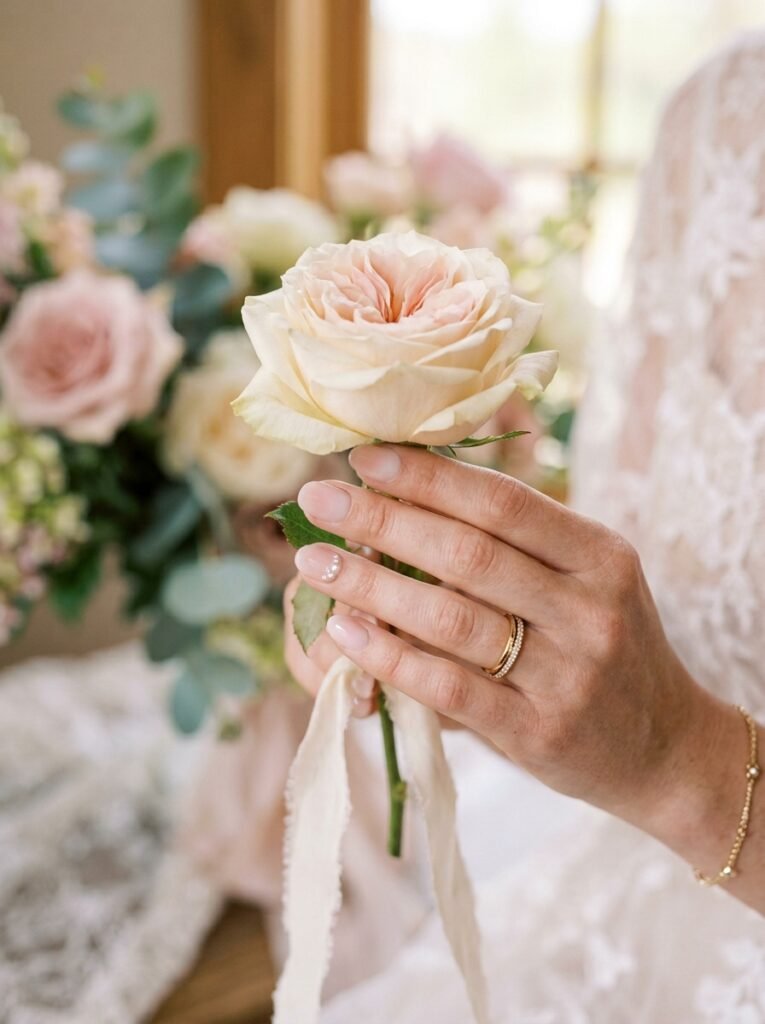
Blush Pink Ombré
A gradient from sheer at the base to blush at the tip, built with a sponge across three light passes.
The two shades sit close together, so blending errors barely register. That makes it one of the more forgiving designs to execute and one of the least likely to disappoint.
Petal Pink Manicure
A muted rose worn as a full colour. Warm pinks suit gold jewellery; cooler pinks sit better with silver and platinum.
Pinks also show tip wear sooner than nudes, because the contrast against the nail bed is higher. A chip has nowhere to hide.
Cherry Blossom Accent Nail
Hand-painted branches on a single nail. This is the most artistic option in the group and the most dependent on the technician.
Bringing a reference image matters more here than for any structured design, since a description communicates almost nothing about branch placement or density.
Soft Ruffian Manicure
A reversed French: colour sits as a band at the cuticle rather than the tip.
That placement has a practical advantage. Colour at the base disguises regrowth as the nail moves outward, so the design holds its look longer than a tip-heavy one would.
Textured and Dimensional Nail Designs
Texture reads in close-up frames where flat colour does not. It also adds chair time, and two of these four snag on fabric.
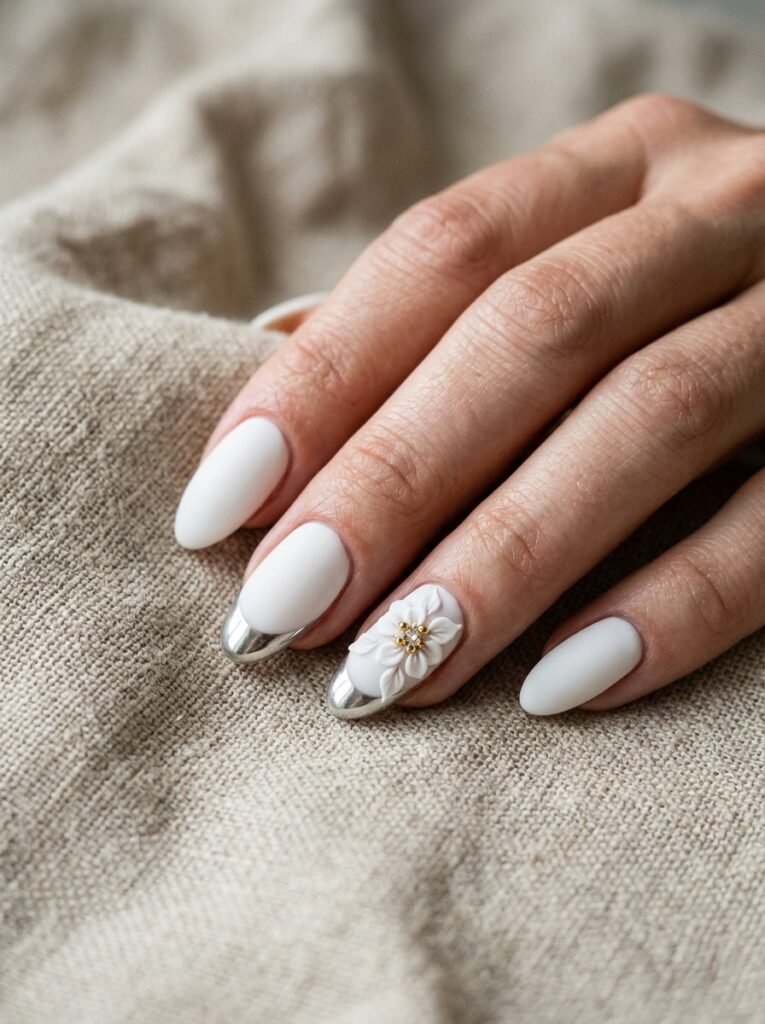
Matte White with Glossy Tips
Two finishes on one nail create contrast without adding any colour. The effect is quiet and reads best at close range.
Matte shows fingerprints and hand cream far more readily than gloss. Applying cream just before photographs will mark it, so the order of operations matters on the day.
3D Floral Appliqués
Sculpted flowers built in gel, adding genuine height to the nail. This is the longest appointment on the list.
Raised work catches on lace, tulle, and beading, so most technicians keep it to one nail per hand. Anyone who has never worn sculpted product should book a trial well ahead rather than testing it on the day.
Subtle Marble Veining
Veining drawn into a wet layer with a fine brush, then blurred before it sets. Timing is the whole skill.
Drawn too early, the lines spread and muddy. Too late, they read as hard strokes rather than stone. Every nail comes out different, which is intended and also forgiving.
Cat Eye Shimmer
Magnetic polish holds fine metallic particles that align when a magnet passes over the wet surface. The result is a shifting band of light.
Champagne and soft silver suit bridal palettes better than the deep shades this technique is usually shown in. The particles must be aligned and cured immediately, so the technician’s speed affects the result.
Metallic and Statement Bridal Nails
Metallics are the group where jewellery matching matters most. A gold accent beside platinum rings reads as an accident rather than a choice.
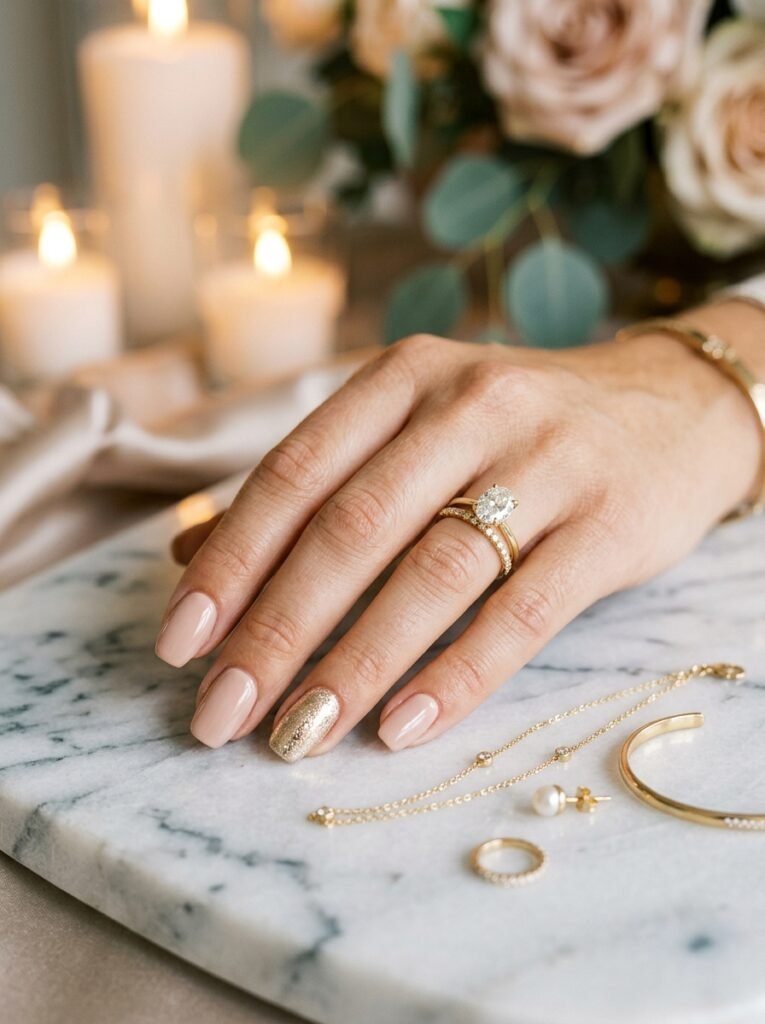
Champagne Gold Accent
One metallic nail among nudes or whites. It adds warmth without committing the whole hand.
Champagne shifts noticeably between daylight and warm reception lighting, drifting toward copper indoors. Holding the shade beside the actual wedding band settles whether the two agree.
Fine Gold Foil Details
Thin leaf pressed into a tacky layer and sealed under a top coat. The fragments are irregular, which is the appeal.
Deliberate even placement usually looks worse than a scattered one. Foil also disguises wear better than most finishes, since the pattern was never uniform to begin with.
Silver Chrome French
A chrome line replacing the white tip. Cooler and more modern than the original, and a natural match for platinum or white gold.
Chrome needs a gel base, so this cannot be done in regular polish. The reflective line also exaggerates any unevenness along the free edge.
Minimalist Line Art
Thin gold or white lines in simple geometric patterns on one or two nails. A striping brush draws them in minutes.
Because the design is sparse, it survives a few days of growth without the composition breaking. That makes it one of the cheapest and most durable ways to add interest.
How to Choose the Right Bridal Nail Design for You
Four questions narrow twenty options down to two or three.
Start with the gown fabric. Lace pairs with a lace overlay, satin with a glass or marble finish, pearl beading with pearl tips. Echoing one texture is enough; echoing three turns the hand busy.
Then look at the ring. A halo or a heavily set band competes with detailed nails, so a simpler finish serves it better. A solitaire leaves room for more decoration.
Metal comes next, and it is the easiest thing to get wrong. Gold and champagne sit with yellow gold; chrome and silver sit with platinum and white gold. Mixing reads as unplanned rather than eclectic in close-up frames.
Finally, be honest about daily habits. A bride who never wears more than plain polish is unlikely to enjoy sculpted 3D work for fourteen hours.
Practical Tips for a Manicure That Lasts All Day
Four choices decide how the manicure holds up from the first look to the send-off.
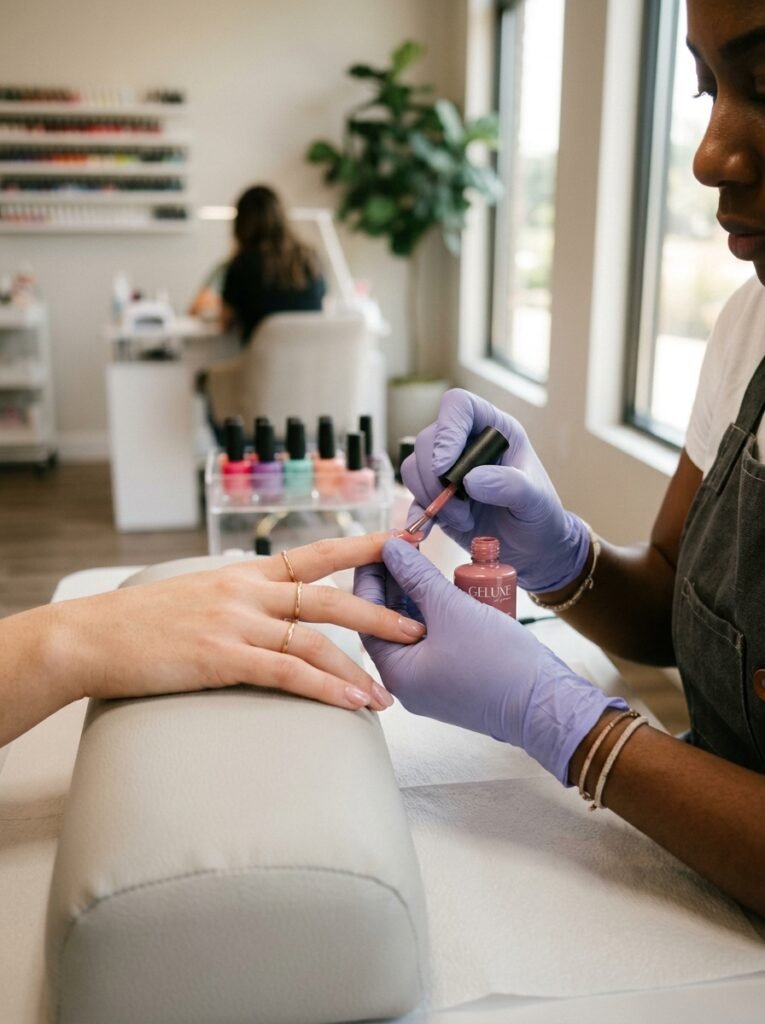
Gel or dip resists chipping far better than regular polish. Both need professional removal, though, which matters for anyone flying out the next morning. The full formula comparison sits in this guide to choosing a wedding manicure.
Book a trial a few weeks ahead, the same way hair and makeup are trialled. It tests the design in real light and surfaces any reaction to the product on an ordinary week.
Keep hands moisturised in the run-up. Cuticle oil applied daily for two or three weeks keeps the nail plate flexible, and flexible nails chip less than dry ones.
Schedule the manicure two to three days before the wedding rather than the morning of. That gap leaves margin to fix a lifted nail without regrowth showing at the cuticle.
Common Mistakes to Avoid
Choosing a design without considering the dress. An ornate gown and a detailed manicure compete rather than complement. One of the two should stay quiet.
Skipping the trial. A saved photograph shows the design on someone else’s nail bed, under someone else’s lighting, at someone else’s length.
Booking late. Technicians who specialise in detailed bridal work fill up months ahead during peak season, and 3D or freehand work needs a long slot.
Judging a shade under one light source. This is the mistake with the clearest explanation behind it. An open textbook on colour theory from RMIT University notes that whites, greys, beiges, pinks and mauves are among the shades most prone to metameric failure — colours that match under one light and stop matching under another. That list is close to the entire bridal palette. The same source recommends laying swatches and accessories out under different lights before committing, which is exactly what a bouquet, a gown, and a polish bottle deserve.
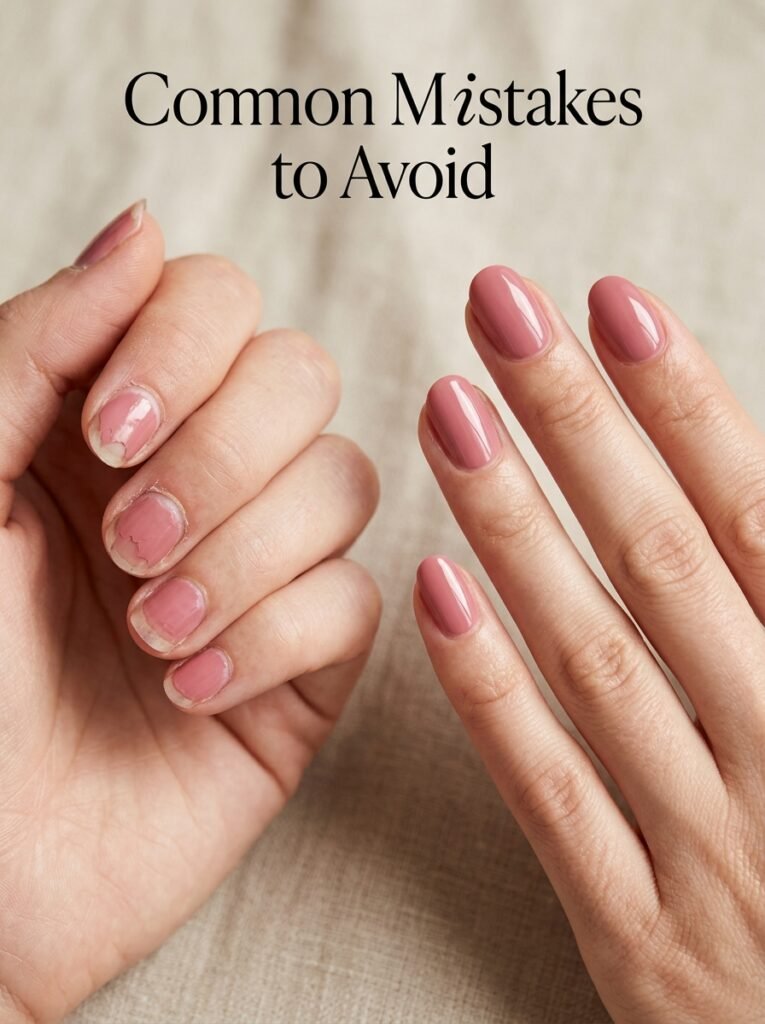
Ignoring nail condition. Brittle or peeling nails show through any design, and a care routine needs months rather than days to make a difference.
Expert Insights from Bridal Nail Artists
Bridal technicians return to the same few points. Simplicity photographs better than most brides expect, particularly in ring shots where a busy design pulls attention off the ring itself. Many also suggest trialling hair, makeup, and nails together, since each element changes how the others read.
A second theme concerns what happens afterwards. A design with a classic base — a French tip or a soft nude — can be recreated in a simplified form for everyday wear. Something built on sculpted work or heavy embellishment cannot. A wider range of design options appears in this collection of wedding nail designs.
Frequently Asked Questions
What is the most popular bridal nail design? The classic French manicure. It suits every dress style, every skin tone, and both metal families, which removes it from the list of things needing coordination.
Should bridal nails match the bridesmaids? Not identically. A more elevated version of a shade the bridesmaids also wear keeps the party cohesive while leaving the bride distinguishable in group photographs.
How far in advance should a bridal manicure be booked? Two to three days before the wedding for gel or dip. The appointment itself should be reserved months ahead if the design needs a specialist.
Are long nails better for wedding photos? No. Medium length photographs more naturally and handles the day’s practical tasks — adjusting a veil, holding a bouquet, sliding a ring on — without complication.
Which nail shape suits a bridal manicure? Round and squoval both look elegant without drama, and both catch on fabric less than a pointed shape. The natural nail bed decides which sits better.
Final Thoughts
A bridal manicure carries more weight than its size suggests, because hands appear in nearly every meaningful frame from the day. The choice is less about finding the prettiest design than about finding one that agrees with the gown, the ring, and the metal already chosen.
Plan it the way the rest of the look was planned. Book a trial, hold the shade beside the dress fabric and the wedding band under more than one light, and pick something that survives handshakes and photographs equally well. Simple finishes tend to win on both counts.


[…] better. For brides comparing pre-wedding options, the same durability advantage applies to bridal nail designs that need to hold up through a full day of […]