
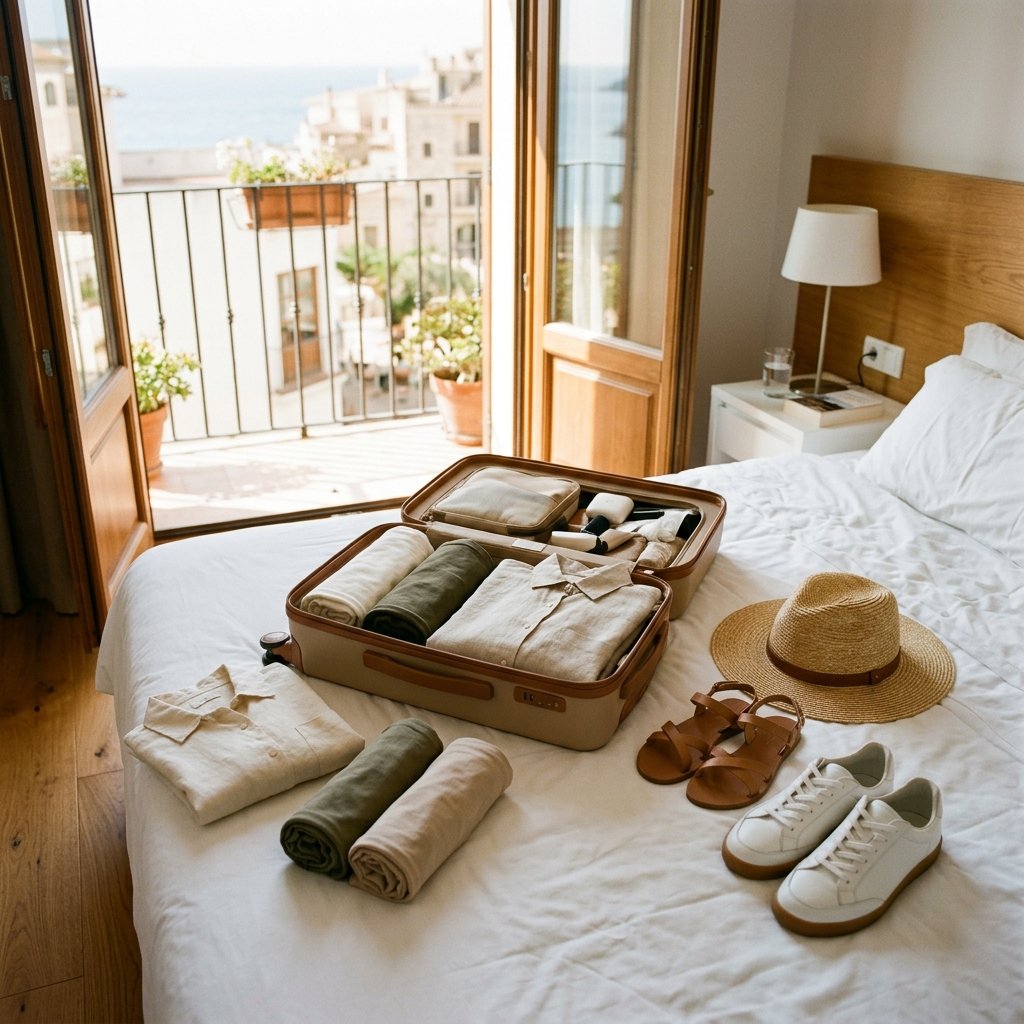
I once came home from ten days in Portugal having worn four things. Four. Out of a suitcase so full I had to sit on it to close the zip.
The rest came home clean, folded, and untouched. A silk top I was saving for a nice dinner that never happened. Three pairs of shoes I never took out of their dust bags. A dress I bought specifically for the trip and then felt too self conscious to wear.
Sound familiar? Almost everyone I know has a version of this story. And the fix isn’t packing less for the sake of it. It’s packing pieces that talk to each other, so that whatever you reach for in the morning already works.
That’s the whole idea behind everything below.
The Rule That Fixed My Packing
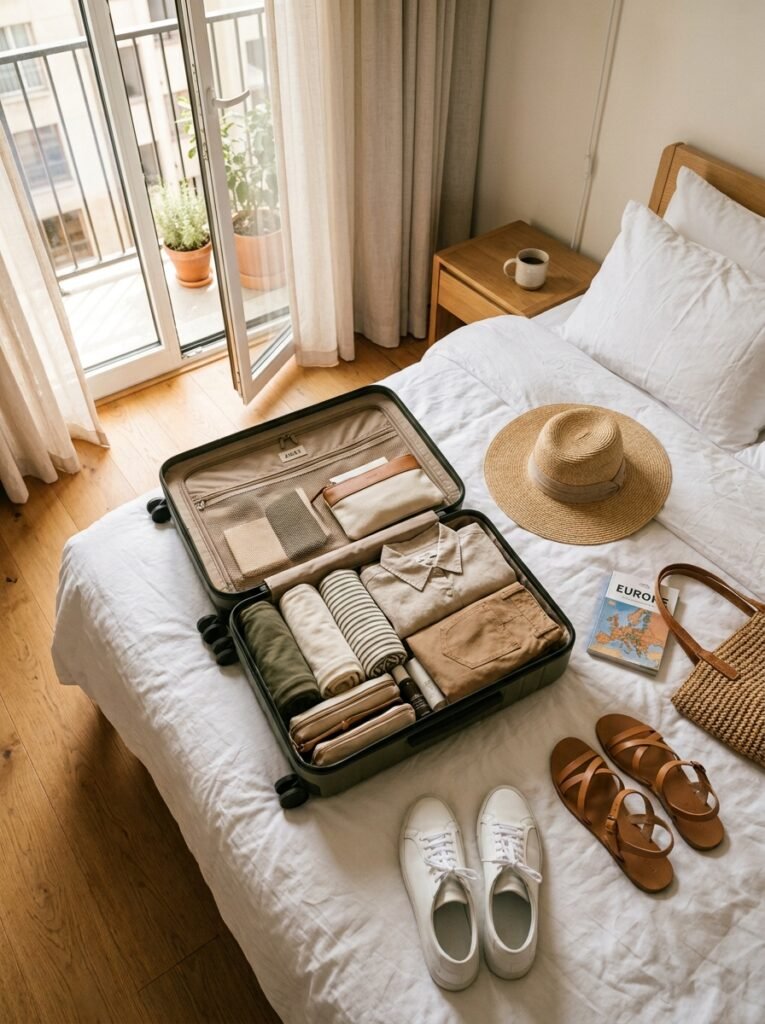
One color story. That’s it. That’s the rule.
Pick two neutrals and one or two accent colors, and everything you pack has to live inside that palette. Cream, tan, and olive. Or black, white, and red. Or navy, beige, and a soft rust.
The reason this works is mathematical rather than aesthetic. When every top goes with every bottom, twelve pieces stop being twelve pieces and start being twenty something outfits. When you pack a purple top, a green skirt, and a burgundy dress, you’ve packed three outfits that can never be anything else.
You’ll also notice you get dressed faster on the trip, which sounds minor until you’re standing in a hotel room at 8am trying to decide whether the yellow thing goes with the blue thing before your coffee has kicked in.
The other half of the rule: everything must work in at least two different outfits. If a piece can only be worn one way, it needs to earn its place some other way, like being the single dressy item for a nice dinner. Otherwise it stays home.
Twelve Pieces That Cover Almost Any Trip
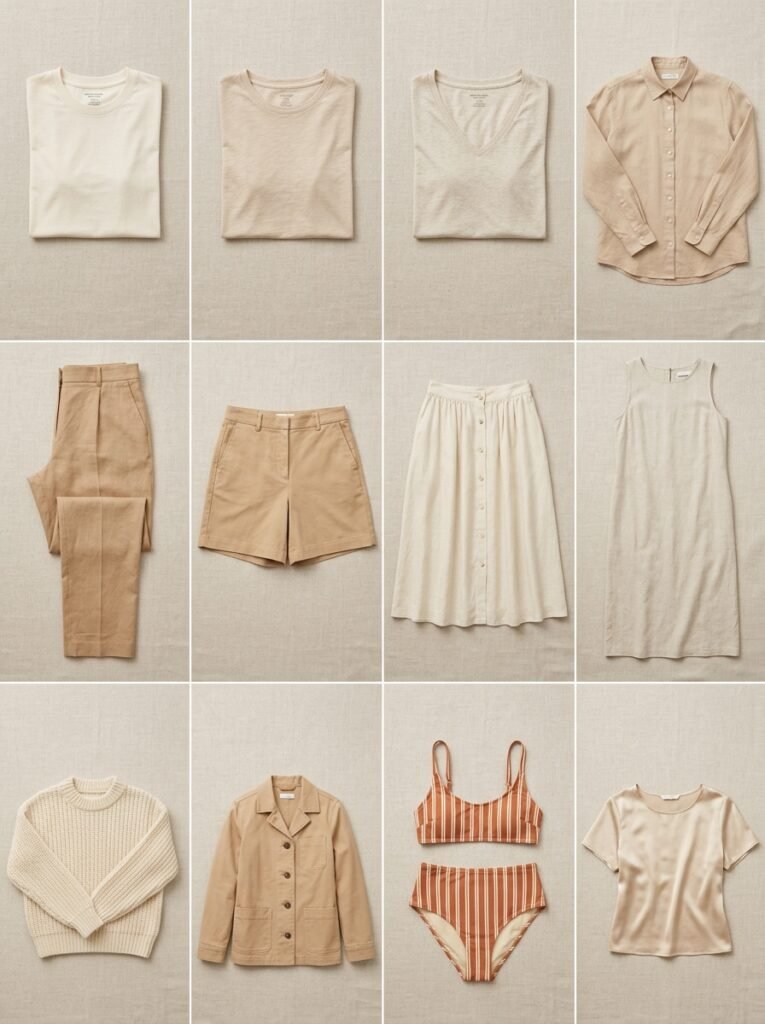
This is the base I start from and then adjust. It fits in a carry on with room to spare.
- Three simple tops. Two short sleeve, one long sleeve. Plain, no loud graphics.
- One button down or overshirt. Doubles as a layer, a beach cover up, and a light jacket.
- One pair of trousers or wide leg pants in a fabric that doesn’t crease badly.
- One pair of jeans or shorts, depending on the climate.
- One skirt or a second pair of shorts.
- One easy day dress. Something you can throw on with sandals or sneakers.
- One knit or sweatshirt. Even in hot places, air conditioning and evening breezes exist.
- One light jacket appropriate to the destination.
- Swimwear, if relevant.
- One dressier item. A slip dress, a silky top, a jumpsuit.
- Underwear and socks for the trip length, plus two spare pairs.
- Sleepwear that could pass as loungewear if someone knocks on the door.
Then accessories: one belt, a couple of pieces of jewellery, sunglasses, a hat if the sun demands it, and one scarf. A scarf is the most useful item in this entire list. It’s a wrap on a cold plane, a head cover at a religious site, a beach towel in an emergency, and a way to make the same outfit look different in photos.
Adjust the quantities up for longer trips, but not by much. A fourteen day trip does not need twice the clothes of a seven day trip. It needs one laundry session.
Outfit Formulas Instead of Outfits
Here’s where the packing list turns into something wearable. Instead of planning individual outfits, plan formulas. Then any pieces that fit the formula will work.
The daytime default. Simple top plus easy bottoms plus comfortable shoes plus one accessory. This covers walking, sightseeing, coffee, markets, and about eighty percent of any trip.
The layered version. Same as above with the button down open over the top, sleeves rolled. Instantly looks more deliberate and handles temperature swings.
The dress and shoes swap. One dress, sneakers by day, sandals or heeled mules by night. Two completely different looks, one item.
The beach to lunch. Swimwear plus a linen shirt plus a skirt or shorts pulled on over. You don’t need a separate cover up if your shirt is doing that job.
The dressed up night. Dressy top plus your best trousers plus the nicer shoes plus jewellery. Or the slip dress plus a knit thrown over the shoulders.
The travel day. Comfortable, layered, and with anything bulky worn rather than packed.
Six formulas. Rotate them across a week and nobody, including you, will notice you’re repeating pieces.
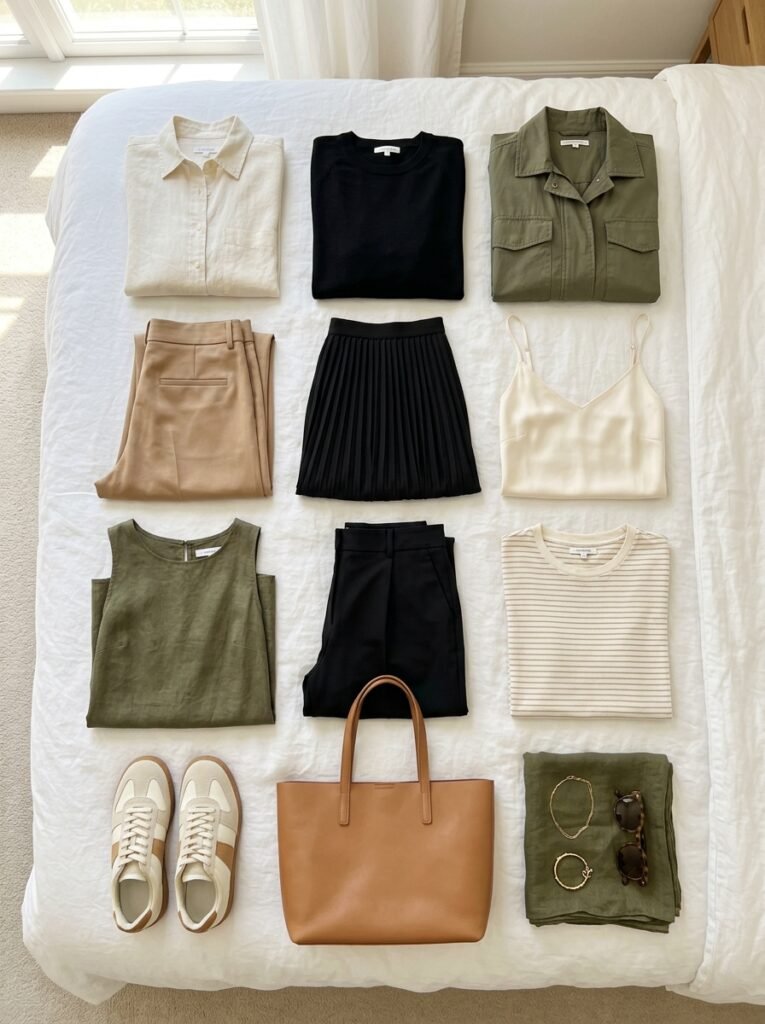
If you want a slightly more visual system, lay out your pieces on the bed before packing and physically build three or four combinations. If a piece doesn’t appear in any of them, it goes back in the wardrobe. This takes ten minutes and saves you dragging dead weight across an airport.
What Actually Changes by Destination
The formulas stay the same. The materials and coverage shift.
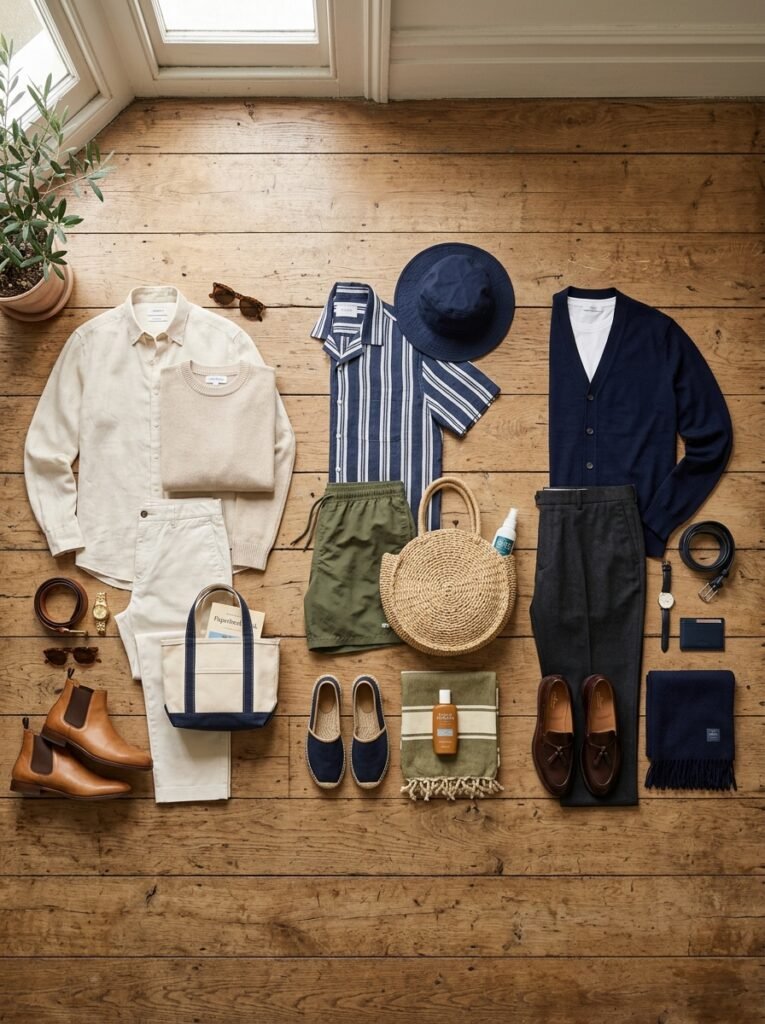
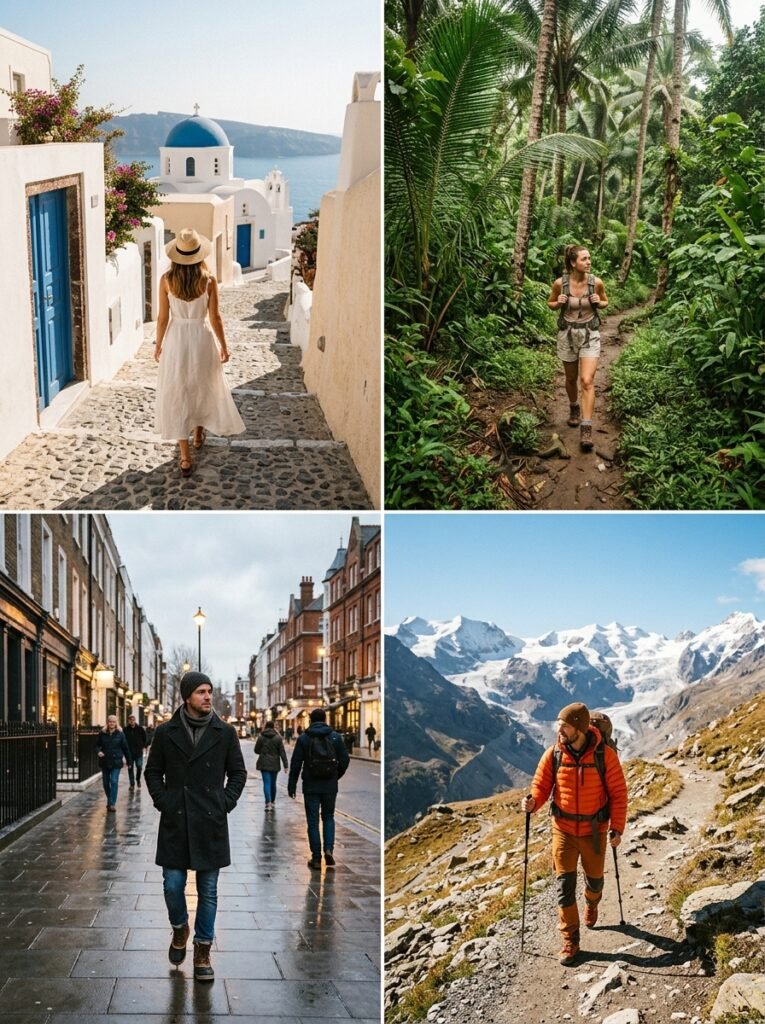
Hot and dry, like southern Europe or the desert. Loose linen blends, light colors, covered shoulders for sun protection rather than modesty. A hat matters more than an extra outfit. Sandals you can walk two miles in, not just wear to dinner.
Hot and humid, like Southeast Asia or the Caribbean. Skip anything clingy. Loose cotton and viscose blends. Bring more tops than bottoms because tops get damp fast. Two pairs of shoes minimum so one can dry out.
City breaks. Slightly smarter than beach dressing. People do notice in Paris, Milan, and Tokyo. Trade shorts for a skirt or trousers, trade flip flops for loafers or clean sneakers. Dark colors hide the reality of a full day walking.
Mountains and hiking trips. Layers, always. A base layer, a mid layer, a shell. Merino wool is worth the price because it stays fresh for days. Cotton is genuinely the wrong choice here since it holds sweat and gets cold.
Cold weather cities. Bulk goes on your body, not in your bag. One good coat, thermal layers underneath, and boots you’ve broken in. Two thin layers beat one thick one for both warmth and packing space.
Mixed climate trips. The hardest kind. Beach days and mountain evenings in one itinerary happen a lot. The answer is layering pieces rather than separate wardrobes: a light knit, a packable jacket, and trousers that work in both.
Conservative destinations. Research before you go, not after. Covered shoulders and knees are commonly expected at religious sites regardless of the country. Loose trousers and that scarf handle almost every situation.
A Real Seven Day Trip, Packed Out
Concrete beats theoretical, so here’s an actual week in a warm coastal city.
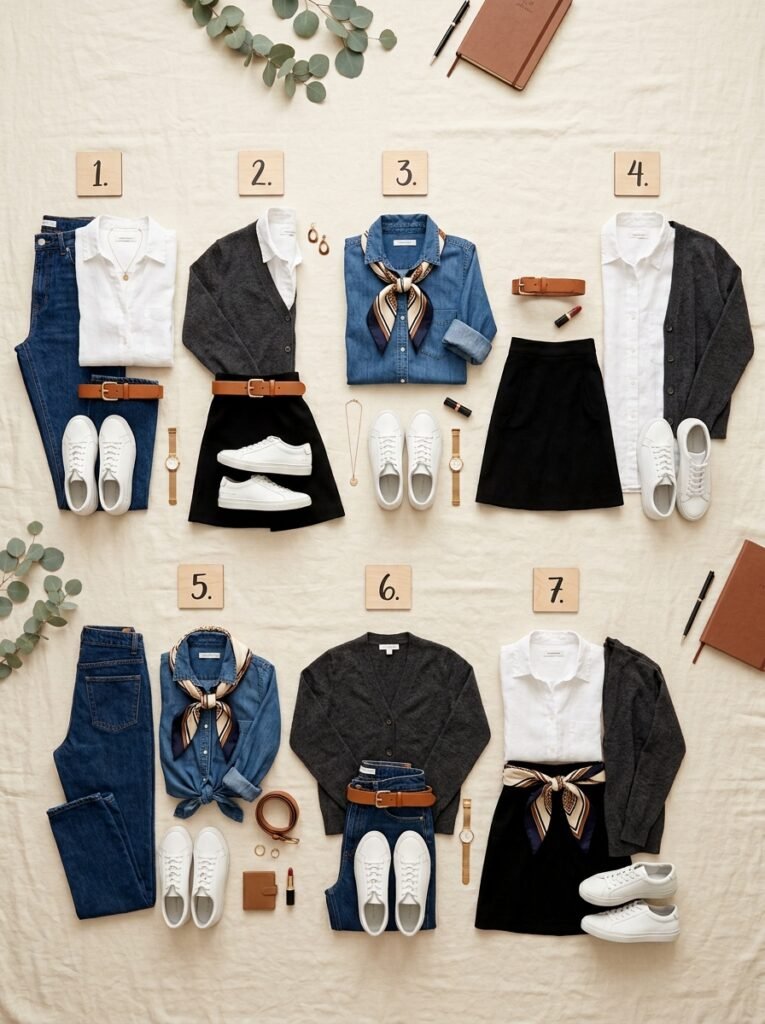
Packed: white tee, cream tee, black tank, tan linen shirt, black wide leg trousers, denim shorts, olive midi skirt, black day dress, light knit, denim jacket, one swimsuit, one silky black top. Shoes: white sneakers, tan flat sandals, black slide sandals. Accessories: straw hat, gold hoops, thin belt, one scarf.
Day one, arrival. Trousers, white tee, denim jacket, sneakers.
Day two, old town walking. Denim shorts, cream tee, linen shirt open over the top, sneakers.
Day three, beach. Swimsuit, linen shirt, denim shorts, flat sandals, hat.
Day four, museums and lunch. Black day dress, sneakers, hoops.
Day five, nice dinner. Black trousers, silky top, slide sandals, gold hoops.
Day six, market and boat trip. Olive skirt, black tank, knit tied over shoulders, flat sandals.
Day seven, flying home. Trousers, cream tee, denim jacket, sneakers.
Twelve clothing items, three pairs of shoes, seven distinct looks, and two items got worn twice with nobody the wiser. That’s the entire point.
Shoes Deserve Their Own Conversation
Shoes are where most suitcases go wrong, because they’re heavy, they’re bulky, and everyone overestimates how many they’ll wear.
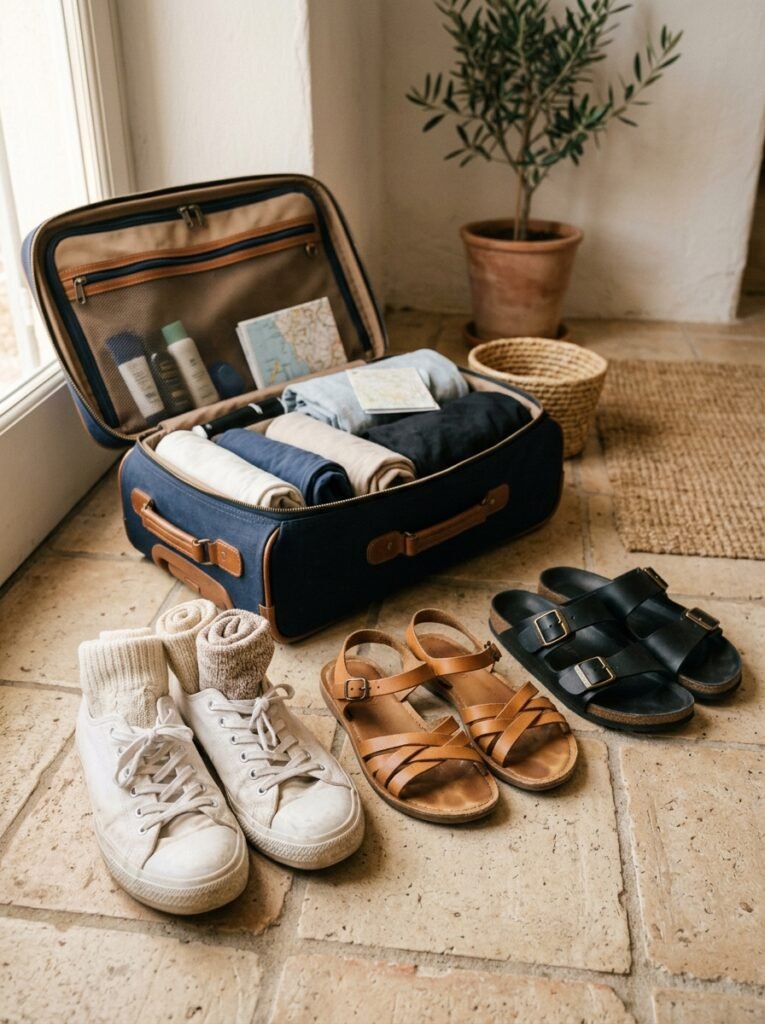
Three pairs is the maximum for almost any trip. One comfortable walking pair, one casual pair like sandals or loafers, and one slightly dressier pair. Wear the bulkiest set on the plane.
Do not pack new shoes. Ever. A brand new pair of sandals on day one of a walking holiday will end your trip before it starts. If you’ve bought something new for the trip, wear it around your house and on a couple of errands first.
Check your walking pair honestly. Cute flats with no support feel fine for an hour and awful after twelve thousand steps. Most cities involve far more walking than people plan for.
Pack shoes in fabric bags or shower caps so they don’t dirty your clothes, and stuff socks inside them to use the space.
If you’re going somewhere with cobblestones, and half of Europe qualifies, leave the stiletto at home. There is no version of this where the heel wins.
The Travel Day Itself
The flight or drive deserves actual thought, because it sets the tone for everything after.
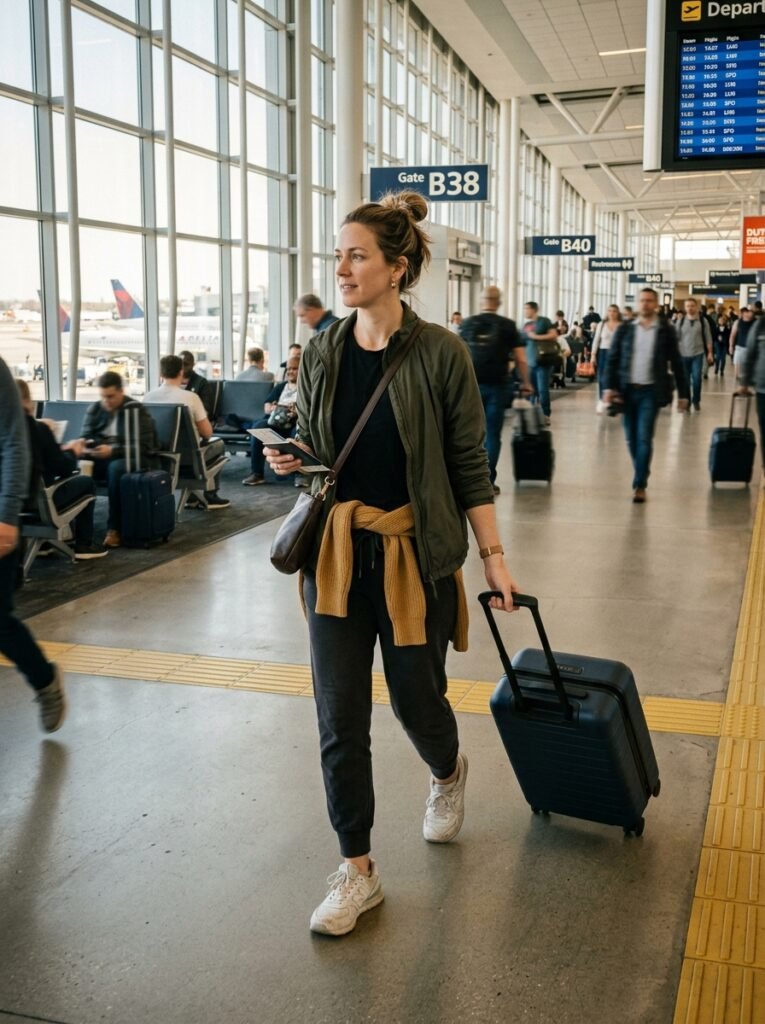
Layers are non negotiable. Airports run hot, planes run cold, and you have no control over either. Something you can add and remove without a bathroom trip.
Wear your heaviest items. Boots, jacket, chunky knit. That’s free luggage space.
Avoid anything with a tight waistband, and avoid anything you’d be upset about if coffee landed on it. Both scenarios are likely.
Choose fabrics that don’t broadcast wrinkles, because you will be sitting in them for hours. Jersey, ponte, and knit blends recover. Crisp cotton and pure linen do not.
There’s a lot more nuance to this than people expect, and this breakdown of outfits that keep you comfortable at the airport without looking sloppy covers the layering and fabric side properly if travel days tend to defeat you.
One more practical thing. Keep a change of underwear, a spare top, and any medication in your carry on even when you’re checking a bag. Lost luggage is annoying. Lost luggage with nothing to change into is a bad first day.
One Nice Night, Handled
Almost every trip has a night that’s a step up. A restaurant with a booking, a rooftop bar, a wedding, a birthday.
Packing for it usually goes one of two ways. Either you bring nothing appropriate and panic shop, or you bring three options for one evening.
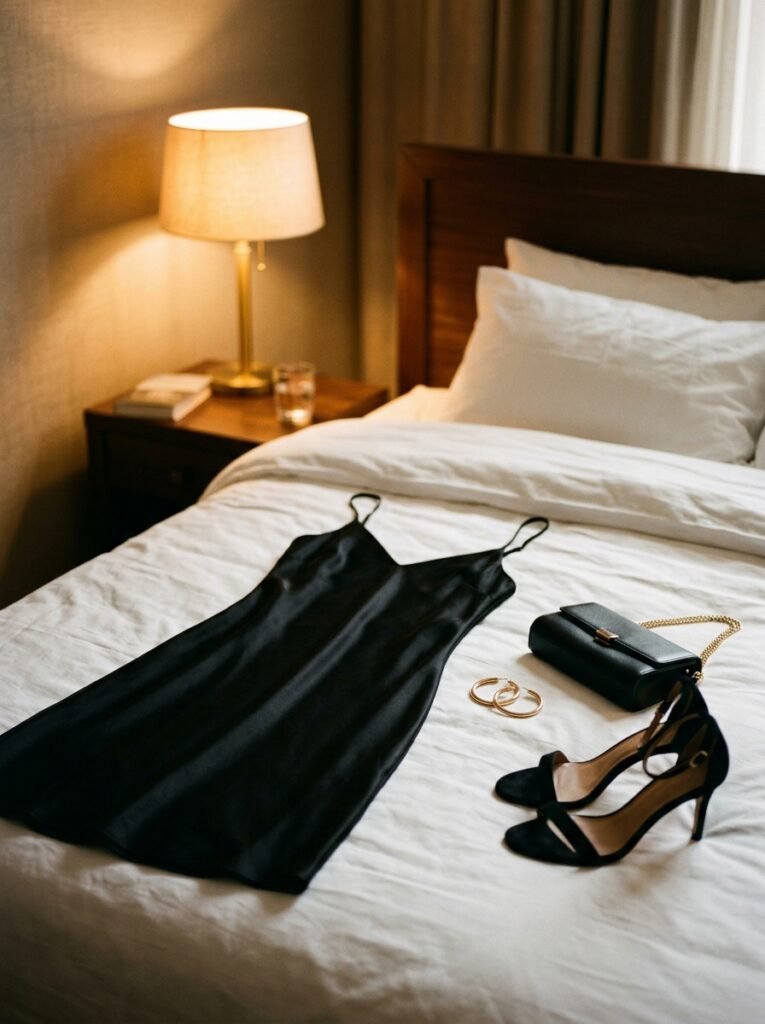
The middle path is a single versatile piece. A slip dress works nearly everywhere and folds down to nothing. A silky top does the same job for people who prefer trousers. A jumpsuit reads as dressed up while being one item.
Then let the accessories do the rest. Better jewellery, a small bag, and the third pair of shoes turn a plain outfit into an evening outfit without extra bulk.
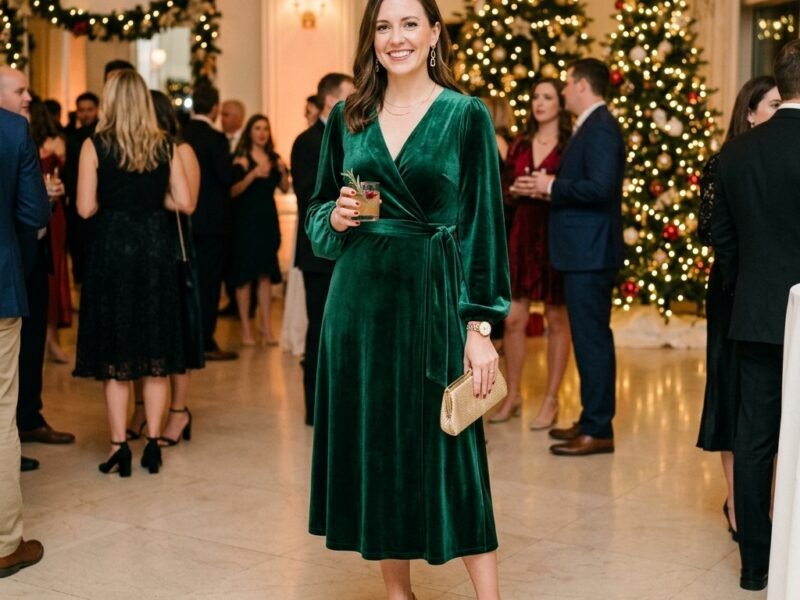
If your trip includes something genuinely dressy, like a party or a celebration where sparkle is expected, plan that outfit before anything else and build the rest of the suitcase around it. These ideas for evening outfits with some shine are a useful starting point for the sort of piece that packs small and still feels like an occasion.
Fabrics That Survive a Suitcase
This is the boring part that makes the biggest practical difference.
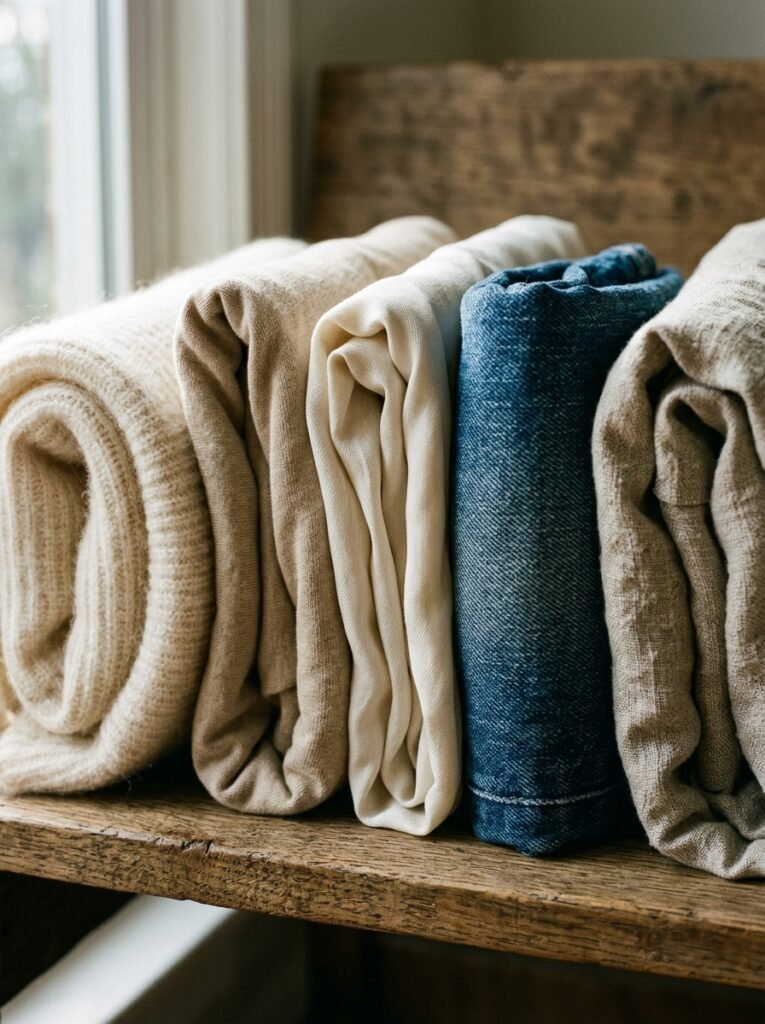
Reliable in a bag: merino wool, jersey, ponte, viscose blends, technical travel fabrics, denim, knitwear, polyester blends.
Difficult: pure linen, crisp cotton poplin, silk, anything heavily structured.
That doesn’t mean never pack linen. It means understanding that linen creases and deciding you’re fine with it, which most people genuinely are once they stop fighting it.
For wrinkles on the road, hang the item in the bathroom while you shower. Twenty minutes of steam sorts out most of it. A travel sized wrinkle release spray weighs almost nothing and works better than you’d expect.
On laundry, a sink wash with a little shampoo and an overnight dry on a hanger handles underwear and tops easily. Quick dry fabrics dry in a few hours. Denim and thick cotton will still be damp in the morning, so don’t wash those unless you have a real machine.
Rolling versus folding: roll soft items like tees and knitwear, fold structured items like blazers and button downs. Packing cubes genuinely help, mostly because they stop you rummaging through everything to find one shirt.
Mistakes That Keep Showing Up
Packing for a fantasy version of yourself. If you never wear heels at home, you won’t in Rome. Pack for the person you actually are.
Too many “just in case” items. Just in case is the reason your bag is heavy. Unless you’re going somewhere remote, shops exist.
Ignoring the weather forecast until the night before. Check it a week out and again two days out, and pack accordingly rather than by season stereotype.
One outfit per day thinking. Bottoms can be worn three or four times. Nobody is auditing you.
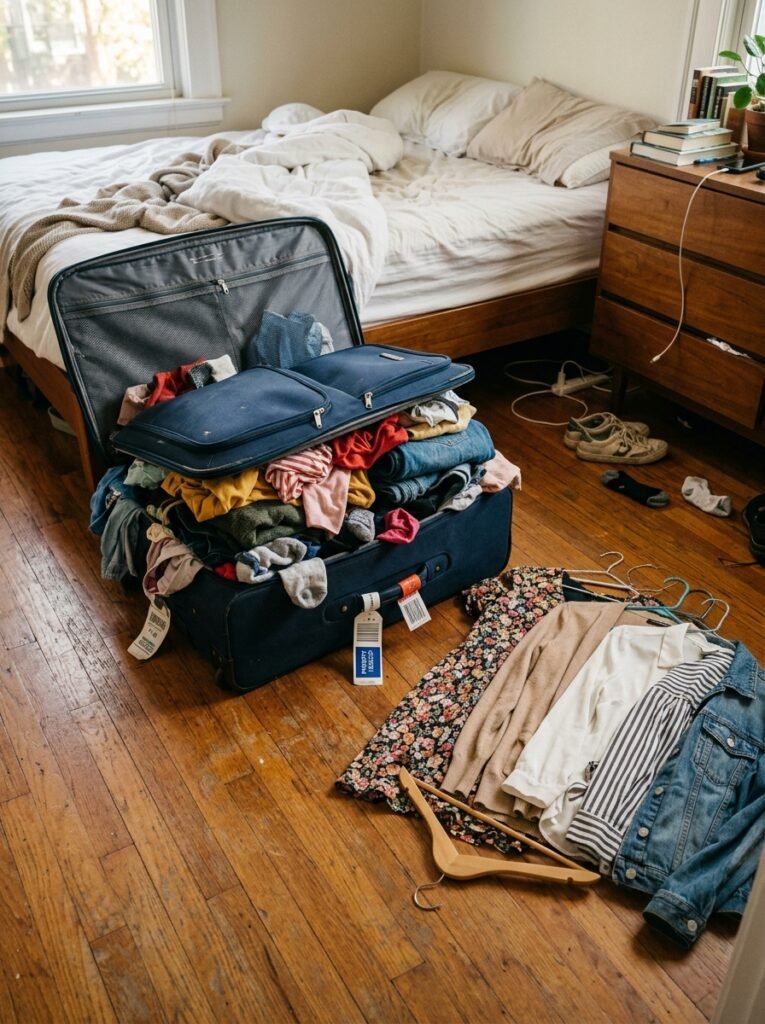
Forgetting the return journey. Leave space for things you buy, or you’ll be wearing four layers through security on the way home.
Skipping the try on. Pieces you haven’t worn in a year might not fit the way you remember. Try everything on before it goes in the bag.
Underestimating sun and cold. A hat and a light layer take up almost no space and prevent two of the most common trip ruining problems.
Questions Travellers Keep Asking
Can I really do two weeks in a carry on?
Yes, with one laundry stop. The bag size is the same for seven days as fourteen. Only the washing changes.
How many outfits should I pack per day?
Fewer than one. Aim for around five to seven combinations for a week and rewear bottoms freely.
What if my trip has hot days and cold nights?
Layer rather than double pack. A light knit and a packable jacket cover a surprising temperature range.
Will people notice if I repeat outfits in photos?
No. And the ones who would notice are not looking. Change your accessories or hair and the photos read differently anyway.
How do I handle a beach and city trip in one?
The swimwear plus linen shirt combination bridges both. Add one smarter pair of trousers and clean shoes for the city days.
What’s the single most useful thing to pack?
A large scarf. It has more uses than anything else of that size and weight.
Should I buy travel specific clothing?
Only if you travel often or are going somewhere demanding. For most trips, what’s already in your wardrobe is fine once you apply the color rule.
Pack the Bag, Then Take Two Things Out
That’s the last piece of advice, and it’s the one I trust most.
Pack the way you normally would. Then look at everything, find the two pieces you’re least sure about, and remove them. You will not miss them. I have never once, in years of doing this, arrived somewhere and wished I’d brought the thing I took out.
What you will notice is a lighter bag, a faster morning, and a week where getting dressed takes ninety seconds instead of twenty minutes.
That’s the actual holiday benefit. Not the outfits. The not thinking about them.

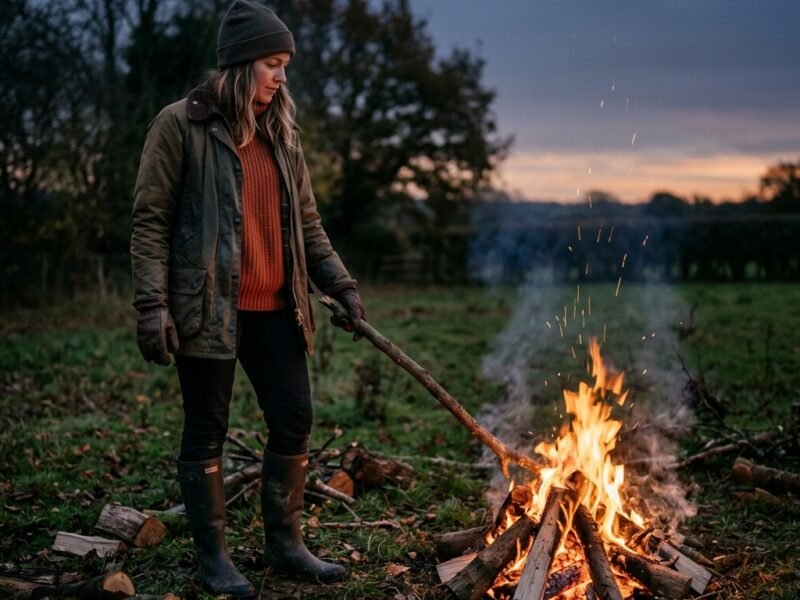

[…] Couples who want a deeper system for building a full mix-and-match wardrobe, honeymoon or otherwise, can find a complete framework in this guide to packing a versatile capsule for any destination. […]
[…] translate into cooler months the same way. For travel-friendly ways to build on this palette, this vacation outfit guide covers packing-light strategies for warm-climate trips. It also breaks down how many linen pieces […]
[…] best as a starting point or a travel wardrobe—useful for anyone packing light, as covered in Vacation Outfit Ideas Packed for Any Destination—with additional pieces added over time for full seasonal […]
[…] of the same climate logic that applies to a general trip applies here too, and a broader breakdown of dressing by destination is worth a look if the wedding is only part of a longer […]
[…] of these need to be flashy. Consistent, well-chosen accessories tend to look more deliberate than statement pieces that don’t relate to anything else you’re wearing. If […]
[…] own rules. Packing one or two outfits from setting two usually covers most evenings away, and the vacation outfit ideas packed for any destination guide is a useful companion for choosing pieces that work from beach days to […]