
School mornings run on a tight schedule, and hair typically ranks last on the priority list. Matching socks, packed lunches, and an actual breakfast usually eat up whatever time exists before the bus arrives. A fifteen-minute hairstyle simply doesn’t fit into that window on most days.
Braids solve that problem efficiently. They clear hair off the face fast, without an elaborate technique or a drawer full of tools. This guide collects twelve braided styles that finish in under five minutes. They’re sorted into ponytail braids, pigtail braids, and braided buns. Full step-by-step instructions accompany each one, so no guesswork is needed on a rushed morning.
Every style below assumes hands working on someone else’s head, not a mirror-guided routine. That distinction changes which techniques hold up fastest in practice. Shapes that forgive a wiggling kid win out over ones needing to look flawless from every angle. Teens doing their own hair for school will find more options in this wider roundup of school morning hairstyles.

Why Quick Braids Are a Busy Morning Lifesaver
A braid outlasts loose hair through an active school day by a wide margin. Fewer flyaways show up by lunchtime. Pickup rarely means a full redo. Braids also keep hair away from the face during recess, gym, and art class. That detail matters more than it first appears.
Braids also add a little variety to a routine that otherwise repeats itself daily. Rotating through a handful of quick styles avoids the sameness of one default look. Most of them still come together with tired hands working half awake.
There’s a practical upside for the child too. A secure braid stays out of paint, glue, and lunch food in a way loose hair rarely manages. Fewer mid-day complaints about hair in the eyes usually follow.

What You’ll Need to Braid Fast
Speed depends on having everything within reach before the first section gets picked up. Hunting for a missing elastic midway through wastes precious minutes. A small basket or pouch stored in the bathroom, stocked with the basics, shaves real time off a rushed morning. It also keeps the whole routine from stalling out halfway through.
A short list of essentials covers most of it:
- Small hair elastics in a few different sizes
- A wide tooth comb or detangling brush
- A handful of bobby pins for stray pieces
- A lightweight detangling spray for second day hair
- A rat tail comb for quick, clean parts
Hair that’s a day past its last wash tends to braid faster and hold longer than hair fresh out of the tub. A bath scheduled the evening before pays off here, on top of the obvious time savings the next morning. Fully dry hair matters too, since damp sections slip out of a braid faster than dry ones do.

Quick Ponytail Braids
These four styles share a ponytail base, which makes them some of the fastest entries here. Gathering hair neatly, usually the hardest part of any style, happens in one single step. From there, each variation only changes what happens to the length hanging below the elastic. A couple of the variations below lean on Dutch and three strand crossing patterns. Anyone needing a refresher on those first can check this beginner’s guide to basic braid techniques.

Braided Ponytail Wrap
All the hair gathers into a ponytail at whatever height suits the day, secured tightly with an elastic. A one-inch section taken from underneath the ponytail braids separately, using a standard three strand pattern. Wrapping that thin braid around the base hides the elastic completely. Tucking the end underneath and pinning it finishes the look in seconds.

Half Braided Ponytail
This version starts exactly like a standard ponytail, gathered and secured with an elastic. Rather than leaving the length loose, only the top few inches get braided, using a simple three strand pattern. A second small elastic closes off that braided section, and the rest of the ponytail falls naturally underneath it. The unbraided length below still swings freely, which some kids prefer over a fully secured braid.

Side Ponytail Braid
All the hair sweeps to one side, low near the ear, and gathers into a side ponytail. An elastic secures the base. The full length then braids down using a standard three strand pattern, finished with a small elastic at the end. Loosening the braid gently with fingers softens the finish, when there’s a spare thirty seconds for it.

Dutch Braided Ponytail
A small Dutch braid starts at the crown, picking up small sections from each side as it travels back. Once it reaches the back of the head, no further sections get added. The braid and the remaining loose hair gather together into one ponytail, secured with a single elastic. The raised texture from the Dutch pattern stays visible right up to where the ponytail begins.

Two-Minute Pigtail Braids
Pigtails earn their place as a school morning staple for practical reasons. Two matching sections make evenness easy to judge at a glance. The style also holds up well through a full day of movement.

Classic Double Braided Pigtails
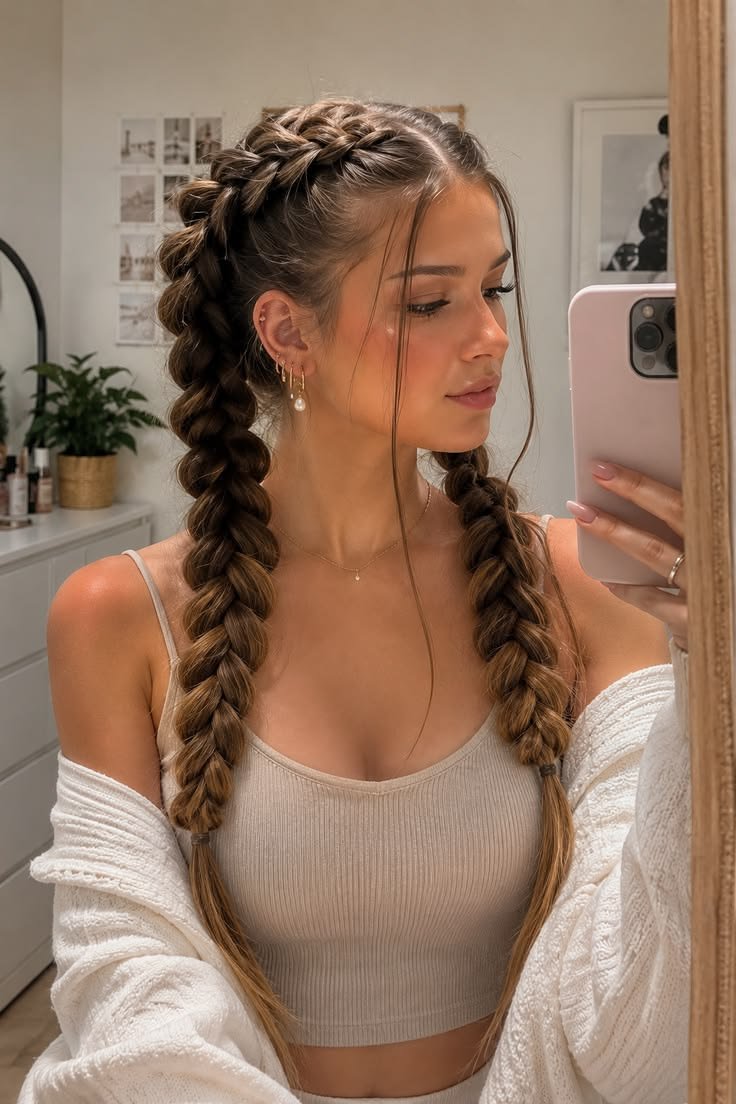
A center part, run evenly from front to back, splits the hair into two sections. Each side gathers into its own small ponytail first. Both sides braid down using a simple three strand pattern. Working the tension evenly on each side, rather than finishing one completely before starting the other, keeps the pair matching. A small elastic closes off each end.

Dutch Braided Pigtails
The same center part used for classic pigtails works here too. A Dutch braid replaces the regular one on each side. It sits slightly raised off the scalp instead of blending flat. Matching elastics close off both ends.

Low Twisted Pigtails
A center part sends each side into a low ponytail near the nape. No braiding happens here at all. Each tail twists from root to end in one steady direction, kept tight, then locks in place with an elastic. This is often the fastest of the twelve styles here. A twist takes noticeably less time than three strands crossing back and forth.

Braided Pigtail Loops
Each side braids into a standard pigtail first, worked all the way to the end. Folding that braided length back upward toward its own base creates a loop shape. One elastic, wrapped around both the base and the folded tip together, holds the loop in place. The finished loops sit higher and stay further from grabbing hands than a full-length pigtail would.

Braided Buns and Half-Up Styles for Busy Mornings
Days calling for something neater than a loose pigtail get these four instead. Each one combines a braid with a bun or half-up shape, without pushing past the five-minute mark.

Braided Bun
All the hair gathers into a ponytail at whatever height works best, secured with an elastic. The full length then braids down using a classic three strand pattern. Coiling that braid around the base builds the bun shape directly. Several bobby pins around the edge hold the coil in place. Of the four styles in this group, this one holds up best through a full gym class.

Half-Up Braided Crown
A small section near one temple braids back toward the crown, using either a three strand or Dutch pattern. A matching section on the other side follows the same path. Both braids meet at the back of the head. A small elastic or a couple of pins joins them, and the rest of the hair stays down. This keeps shorter, face-framing pieces out of the way for glue sticks and finger paint. No full updo is required to manage them.

Single Side Braid Bun
All the hair sweeps over one shoulder before braiding down the full length in a classic three strand pattern. The braid’s end coils into a small bun exactly where it naturally lands near the shoulder. A few bobby pins hold that bun in place. The asymmetry reads as more deliberate than a centered style, despite taking the same amount of time.

Double Braided Bun
A center part sets up two simple pigtail braids, one on each side. Rather than leaving them hanging, each braid twists and coils into a small bun positioned just behind its ear. A couple of bobby pins secure each one. The pair sits low enough to avoid interfering with headphones or a backpack strap.

Tips for Braiding Fast Without Losing Neatness
Speed and neatness aren’t actually in competition once a few habits settle into the routine. Detangling the night before, rather than fighting knots in the morning, saves more time than almost any other change.
A consistent spot for tools also removes the daily hunt for a stray elastic. For anyone still building confidence with the patterns themselves, practicing on a calm weekend beats a rushed school morning. Speed comes from repetition, not from pressure.
Sitting the child at a slight angle, rather than directly facing away, also helps. A side view makes it easier to check that both sides of a pigtail or crown braid match. Catching a mismatch early beats redoing a finished braid.
Common Mistakes to Avoid
A handful of small habits tend to slow down what should be a fast routine. None of them are hard to fix once they’re recognized.
Skipping the detangling step ranks as the most common one, since knots turn every later step into a longer one. A quick comb-through, thirty seconds at most, usually saves more time than it costs.
Elastics that are too small or already worn out cause trouble too. They snap or work loose partway through the day. A small stock of fresh ones, replaced regularly, avoids the problem entirely.
Rushing the very first section is a third common slip. An uneven start compounds into an uneven braid all the way down. A few extra seconds at the beginning, even redone once or twice, saves time overall. It heads off a full redo later.
Braiding the same tight style every single school day is worth a second thought too. The American Academy of Pediatrics notes that consistently tight styling can cause hair loss along the hairline. This condition, called traction alopecia, improves once looser styles take over. Loosening the tension slightly gives the hairline a break. Rotating in one of the twist-based styles above, instead of a tight braid every day, helps too.
Expert Insights: Tips from Stylists and Parents
Many stylists suggest braiding the hair the night before for households that struggle with rushed mornings. A braid slept in overnight tends to leave soft waves behind. Those waves make the next day’s style even quicker to put together.
Parents who braid their kids’ hair regularly often mention one particular fix. A dedicated caddy holding elastics, a comb, and bobby pins removes the supply hunt at the worst moment. That’s usually right as everyone else heads for the door.
Another borrowed tip: pick one or two go-to styles rather than reinventing the routine every morning. Repetition builds speed on its own. A reliable default also removes one decision from an already crowded routine, freeing up attention for everything else on the list.
One more habit shows up often among parents specifically. The child picks the style the night before, rather than during the morning rush. A decision made calmly the night before rarely gets renegotiated at seven a.m. That removes one more variable from an already tight schedule.
Frequently Asked Questions
Which braided style comes together fastest on a school morning? A braided ponytail or classic double pigtails tend to win that race, since both need minimal sectioning. With practice, either comes together in well under five minutes, even before coffee kicks in.
What keeps a braid from coming undone during the school day? Fresh, properly sized elastics do most of the work. A bit of texturizing spray added beforehand helps braids hold through recess, gym class, and general movement.
Is wet or dry hair better for braiding a child’s hair? Slightly damp or second-day hair braids more easily and holds longer than freshly washed, silky hair. A fresh wash right before styling is usually worth avoiding.
What works for a child with hair too short for a full braid? Two small front braids, pulled back and secured with clips, often work better than a full pigtail. That approach needs less length to hold a shape.
What’s the fastest way to build speed at morning braiding? Practicing on a relaxed weekend, away from the clock, builds both speed and confidence. Detangling the night before also removes one of the slowest steps from the morning version.
Conclusion
Quick braided styles cut a fair amount of chaos out of a school morning without sacrificing a neat, finished look. A simple braided ponytail or a pair of classic pigtails comes together fast and holds through a full day. Either way, there’s a little more time left over for actual breakfast. None of the twelve styles above demand a special occasion or a steady hand under pressure.
Starting with one or two favorites turns these styles into second nature before long. Keeping supplies in one easy-to-reach spot speeds that process along. Even the busiest mornings eventually run on autopilot once the pattern sets in.


Leave a Reply