
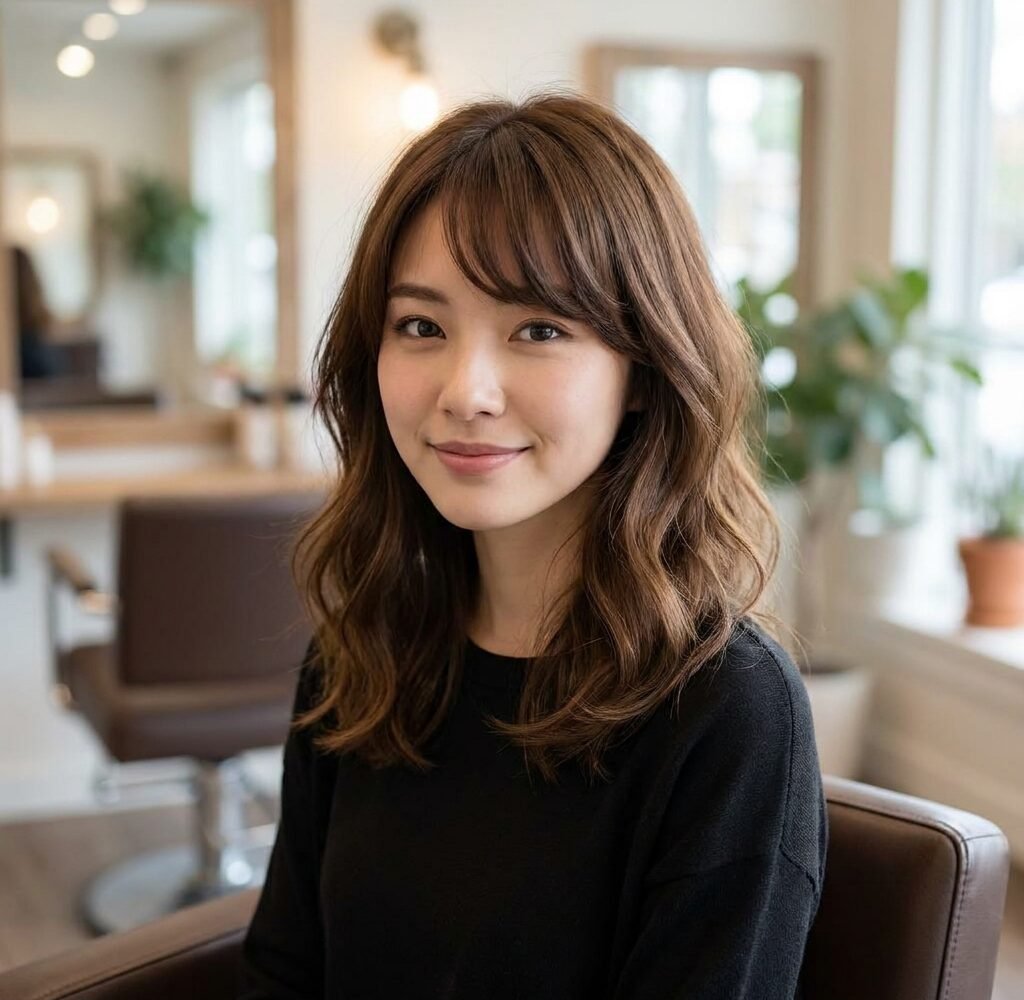
Heart Shaped Face Hairstyles: Balance a Wider Forehead
Take two photos of yourself in the same light. In the first, pull your hair straight back. In the second, add a soft part and let a few strands fall near the temples. The face is identical, yet the second photo often reads as gentler and more evenly proportioned. Nothing about your bone structure changed. Only the hair did.
That small experiment is the idea behind this guide. On a heart shaped face, the forehead and cheekbones tend to be the widest points, and the chin narrows below them. Hair cannot change that outline, but it can change what the eye notices first. Most of the effect comes from three choices: what covers the forehead, which direction the lines run, and where the fullness sits.
Instead of sorting cuts by length, this guide starts with the forehead itself and works outward. Everything here is a styling observation rather than a rule, so treat it as a set of ideas to try and adjust to your own hair.

Why a Forehead Looks Wider Than It Is
A heart shaped face is usually described as broader across the forehead and cheekbones, then tapering to a softer, narrower chin. That description is useful, but it leaves out the part hair controls. How wide a forehead appears depends as much on the hairline and the part as on the bone underneath.
Pull your hair back and look straight at the mirror. You may notice that the temples feel broad. Or the forehead may seem tall rather than wide. Or it might look perfectly proportioned alone and only feel large beside a narrow chin. Each version calls for a slightly different fix.
| What you notice | What may be causing it | What tends to help |
|---|---|---|
| Broad from temple to temple | Hair held tight against the sides, or lift at the crown | Softer temples, less height on top |
| Tall rather than wide | A high hairline or a flat, slicked part | A light fringe or a deeper part |
| Narrow chin beside a broad top | Ends that stop above the jaw, with fullness sitting high | Weight moved to the jaw and below |
| Sharp or pointed hairline | A strong widow’s peak shown by a straight center part | A slightly off-center part |
These are visual tendencies, not diagnoses. Most faces mix two or three of them, which is why a single “best haircut” rarely fits everyone.
Three Ways Hair Can Balance a Forehead
Nearly every flattering style for this face shape relies on one of three moves. The most convincing looks usually combine two.
Covering
Covering means placing hair across part of the forehead, most often with a fringe. It shortens the visible height and breaks up the width. Partial coverage tends to look more natural than total coverage, because a little skin showing keeps the face open and light.
Redirecting
Redirecting works through angles. A diagonal line from a side part or a swept fringe pulls the eye across the face instead of along the widest stretch. Face-framing pieces do something similar by creating lines that travel down toward the jaw.
Counterweighting
Counterweighting adds fullness lower down, around the cheekbones, jaw and ends. When the bottom half of a style carries more visual weight, the narrow chin feels anchored and the forehead stops being the main event.
A simple example shows all three at once: a swept fringe covers, a soft off-center part redirects, and waves that begin near the jaw add weight below.
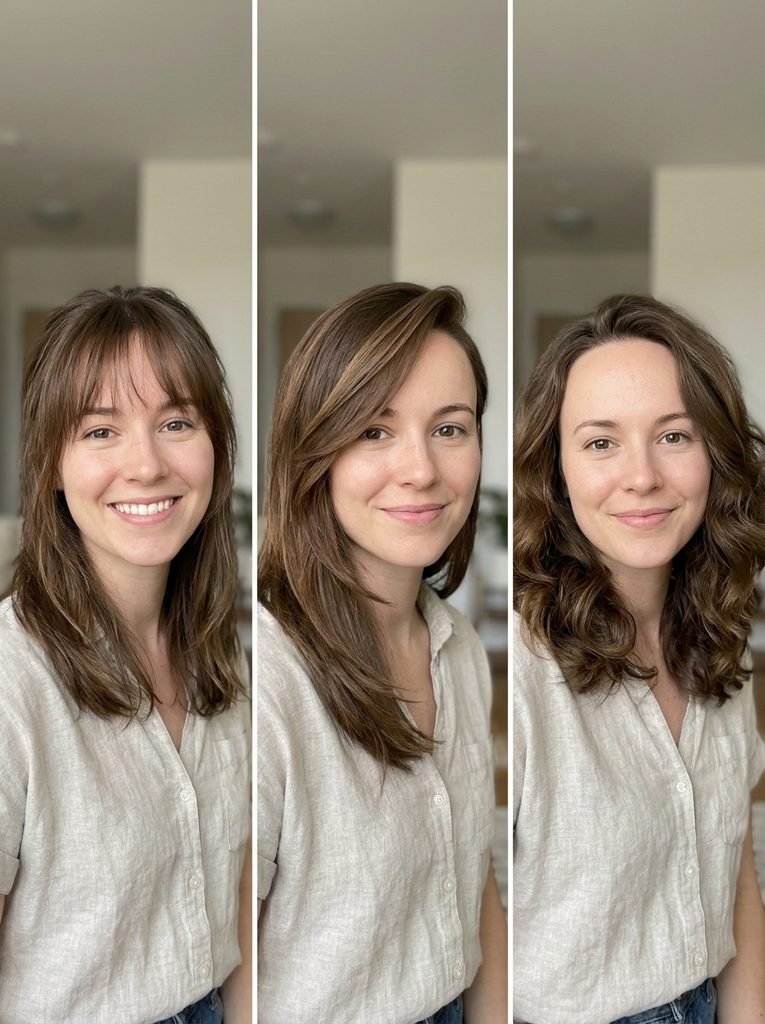
Fringe Shapes, Sorted by How Much Forehead They Cover
Fringe is the most direct tool, and the options range from barely there to substantial. Sorting them by coverage makes the decision easier than sorting them by name.
| Fringe | Forehead coverage | Visual effect |
|---|---|---|
| Face-framing layers, no fringe | None | Open forehead, soft lines at the sides |
| Long side sweep | Partial, one side | A diagonal across the brow |
| Curtain bangs | Partial, open center | Parted and flowing outward |
| Wispy, see-through fringe | Light, across the whole width | A hint of cover with skin showing through |
| Bottleneck bangs | Moderate, fuller center | Short in the middle, flaring at the sides |
The long side sweep is the gentlest introduction to bangs. It crosses the forehead on a diagonal, which interrupts the widest horizontal stretch while leaving one temple uncovered. Because it blends into the rest of the hair as it grows, it is also easy to live with.
Curtain bangs part in the middle and travel outward, so the center of the forehead stays visible while the temples are framed rather than blocked. Versions that end near the cheekbone tend to look softer than ones that stop at the brow. Our guide to curtain bangs and what to ask for covers length and grow-out in detail.
Bottleneck bangs keep more hair in the center and widen toward the sides. That gives extra coverage up the middle of the forehead while the flared edges lead the eye to the cheekbones. If you want to see how that outline differs from a full fringe, this breakdown of bottleneck bangs lays it out clearly.
A wispy fringe suits anyone who likes the idea of cover but not the weight of a solid curtain. The strands separate, so some forehead shows through, and the effect stays airy.
One shape deserves a note of caution. A heavy fringe cut straight across at one length draws a hard horizontal line right at the widest point. Texturizing the edge or choosing a gentle curve softens that line considerably.
Prefer no fringe at all? Long face-framing pieces that begin near the cheekbone can do much of the same softening. The examples in these long hairstyles with face-framing pieces show how those layers look in photos.
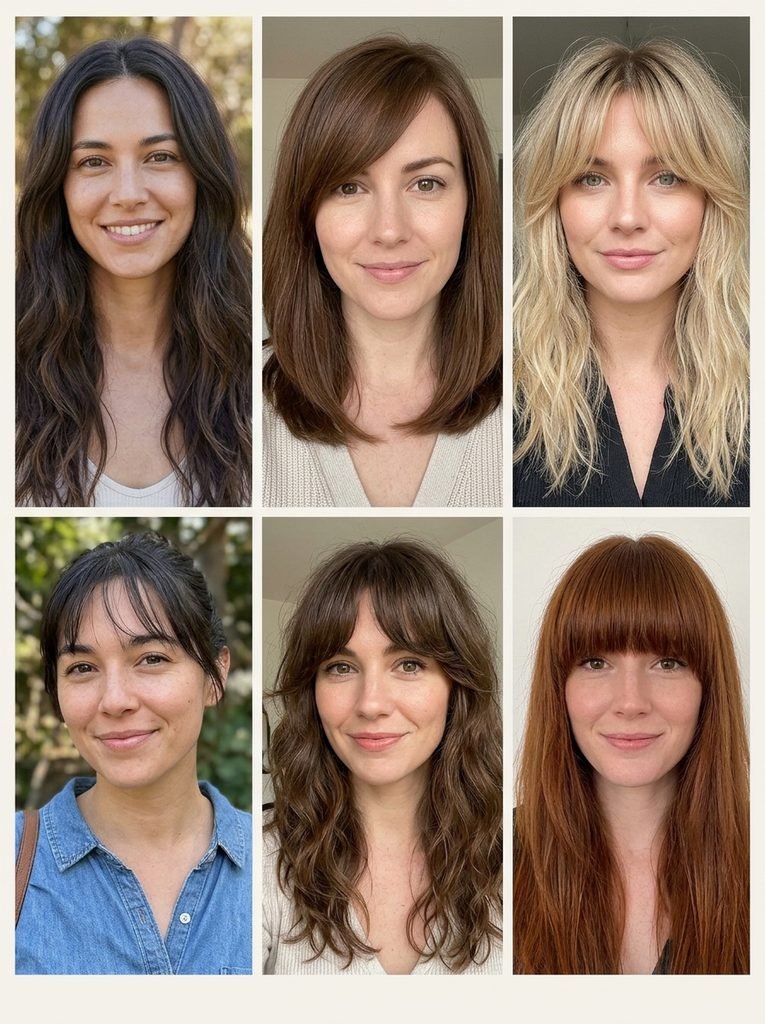
The Part Is the Quietest Tool
A part rarely gets much attention, yet it decides how the forehead is divided.
A straight center part splits the forehead into two equal halves and shows off the symmetry of the hairline. On a heart shaped face it tends to work best when softened by curtain bangs, loose waves or a few pieces left out at the temples. A razor-straight line with hair slicked flat shows the full outline. That can be exactly the look someone wants, but it is the least forgiving version.
Moving the part about an inch off center is a small shift with a visible result. The forehead is no longer divided evenly, and the heavier side of hair falls across one temple. A deep side part pushes the idea further and creates a long diagonal, although too much volume piled on one side can look lopsided.
A zigzag part is the less obvious option. The broken line blurs the border between hair and skin, which can soften a sharp widow’s peak. A fingertip or the tip of a fine comb is enough to create it.
Habit plays a role too. Hair parted in the same place for years tends to lie flat there and fall back whenever it is disturbed. Dry the roots in the direction you want the new part to go, using a little heat, and the change usually holds for the day.
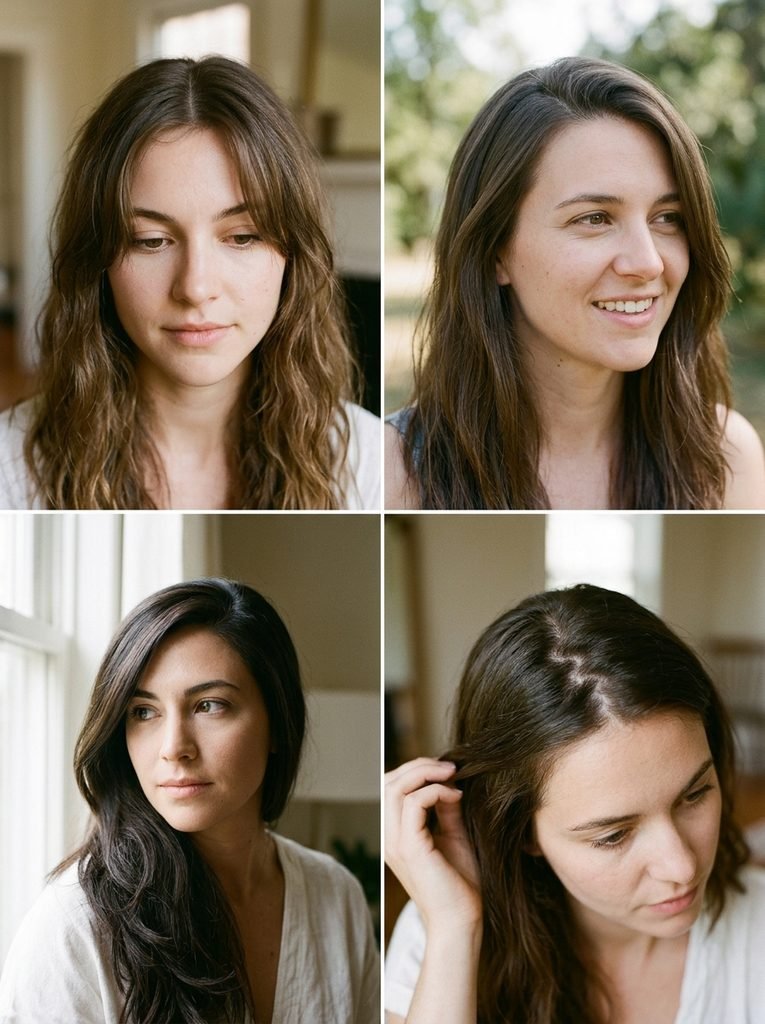
Working With Your Hairline Instead of Against It
Hairlines are not uniform, and two people with the same face outline can need different styling.
A widow’s peak shows most when hair is parted in the center and pulled back. A side part or soft fringe crosses it, while loose waves swept back can make it look deliberate. Plenty of people simply leave it visible.
A high hairline adds height to the forehead. A fringe that lands near the brow shortens the look, and a longer side sweep covers more territory without feeling heavy.
Fine, short hairs at the temples do not need to be hidden. Leaving them free softens the corners where hair meets skin. Heavy gel or tightly slicked edges tend to sharpen those corners instead.
A cowlick at the front pushes a fringe in unexpected directions. Dry the area while damp, pulling against the direction of the lift. It is also worth mentioning before any fringe is cut, since it affects how short the shortest piece can safely be.
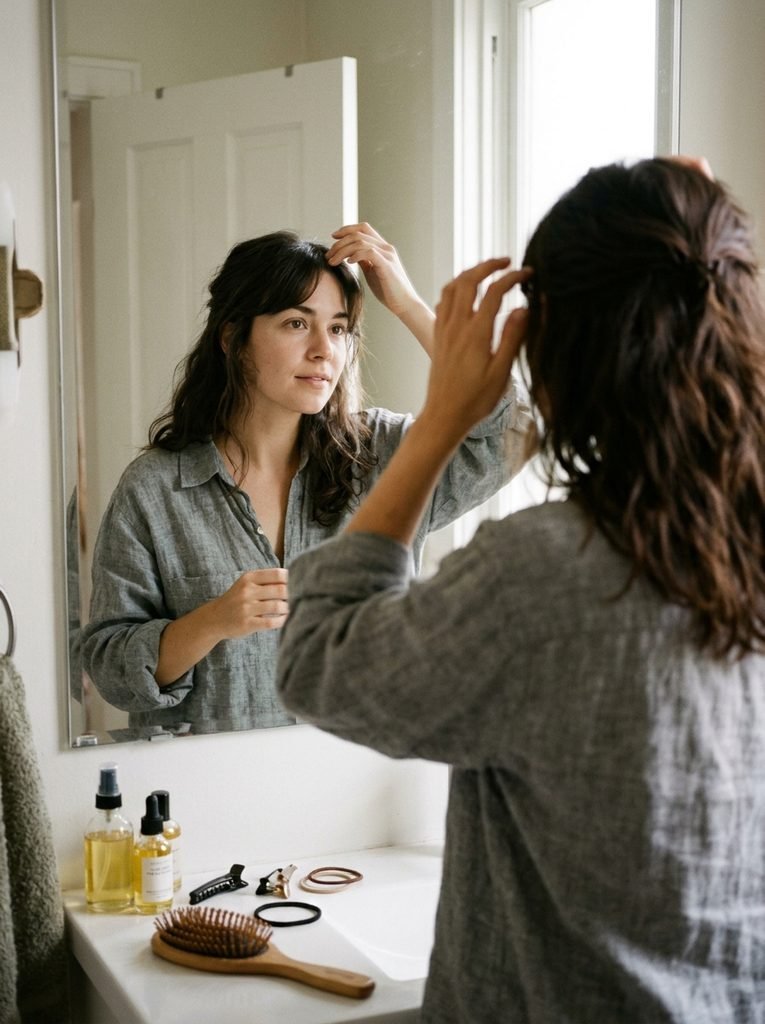
Where the Fullness Should Live
The weight idea is easiest to understand by hair type, because each texture builds width in a different place.
Straight hair can fall flat at the jaw unless the ends have shape. A slight bevel, a gentle turn, or a blunt hem at the jaw or collarbone creates the width that straight strands do not provide on their own.
Wavy hair has a natural advantage, since waves often bulge through the mid-lengths. A cut that keeps those waves below the cheekbone leaves the crown calmer and the jaw fuller. Working product in from the ears down, rather than from the roots, keeps the lift where it counts.
Curly and coily hair builds width easily, so the question becomes distribution. Shaping the cut so the fullest curls sit around cheekbone and jaw level, with less bulk on top, keeps the proportions pleasant.
Fine hair can look wispy at the ends, which pulls the visual weight upward. Keeping the perimeter dense and skipping heavy layering near the crown helps hold fullness low.
Thick hair carries the opposite risk, with bulk gathering at the top. Internal layers that remove weight from the upper section, with length left at the ends, shift the balance back down.
Between haircuts, a few styling habits help. Turn the ends outward with a round brush, use hot rollers on the lower half only, or smooth a light cream through the lengths. Root-lifting sprays at the crown are worth skipping, because they add height exactly where it is not wanted.

Color Can Do Some of the Work
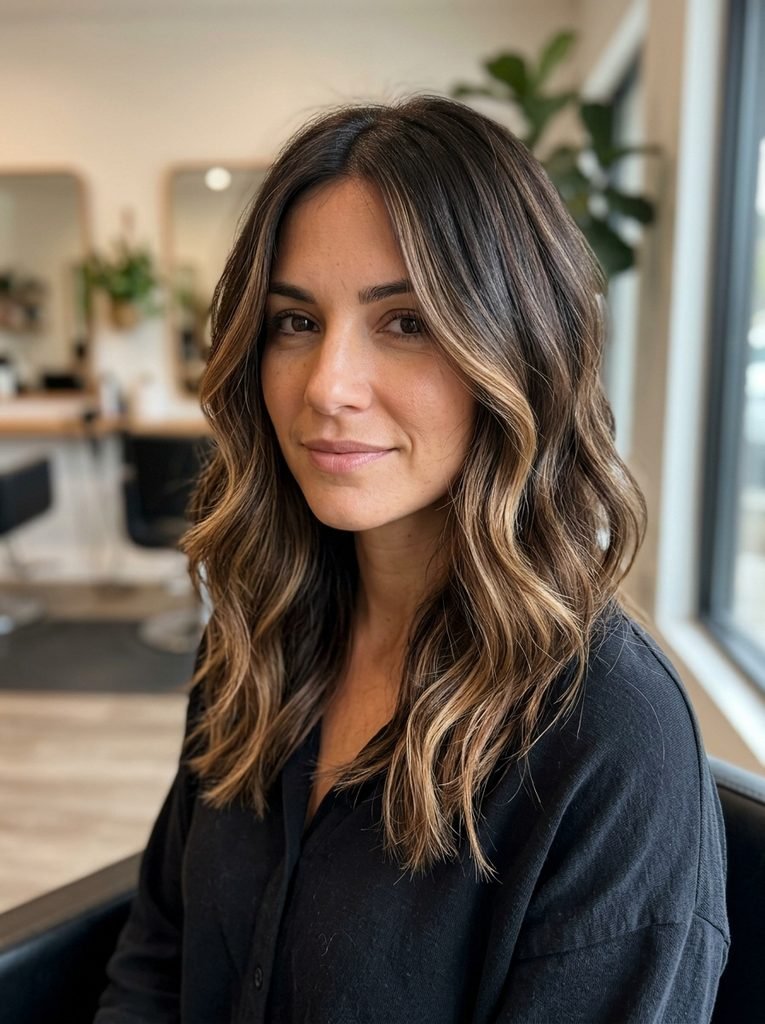
Color placement changes where the eye travels. Lighter pieces around the jaw and below pull attention downward, which echoes what counterweighting does with shape. Bright strands right at the temples can do the opposite and put a spotlight on the widest point.
A slightly deeper shade at the roots can also soften the contrast where the hairline meets the skin, since the border looks less defined. That is a visual impression rather than a guarantee, and it varies with skin tone and hair color.
If you bring reference photos to a colorist, point to where the brightest piece begins. For this face shape, a face-framing highlight that starts at the cheekbone usually sits differently from one that starts at the forehead, even when the shade is the same.
Pulled-Back Days Without the Full Reveal
Pulling hair back exposes the whole forehead, which is the very thing most people are trying to balance. A few adjustments keep some softness in place.
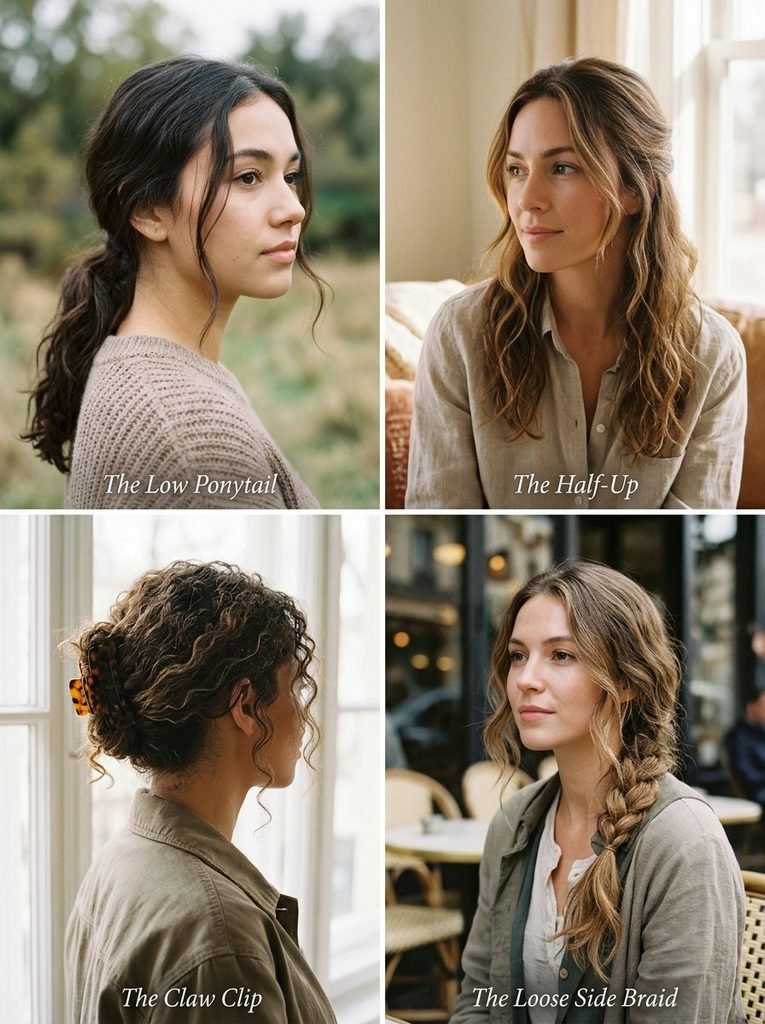
For a ponytail, set it low, at the nape or mid-height, rather than at the crown. Pull two thin strands loose near the temples before securing it, and leave a face-framing section out if you have one.
Half-up styles work well when the section above each ear is nudged slightly forward. That small amount of hair over the temple corners hides the sharpest part of the forehead line.
A claw clip sits lower at the back and leaves the sides loose, which makes it a friendly option. The claw clip hairstyles guide shows placements for different lengths.
A loose side braid over one shoulder keeps fullness near the jaw. Buns follow the same logic as ponytails: low and slightly undone looks softer than a tight top knot with every strand drawn away from the face.
Headbands deserve a mention too. A thin band set a little behind the hairline lets some hair rest forward, while a wide band placed right at the hairline frames the forehead more strongly.
Test the Idea Before You Commit
You can preview most of this at home. Take straight-on photos in even light and compare them: hair pulled back, a center part, an off-center part, and a front section pinned forward to imitate a fringe. Pinning also shows where a fringe would land before anyone picks up scissors.
When you review the photos, look for the moments where the eye goes straight to the forehead, and the ones where it travels across the whole face. The second group is the direction to keep.
At the appointment, specifics matter more than style names. Say where the shortest piece should land, such as the brow or mid-forehead. Mention how much of the forehead you want visible, and where the fullest part of the cut should sit, whether at the cheekbone or the jaw. A short phrase like “soft at the temples, fullest around the jaw” gives a stylist more direction than a haircut name alone. Reference photos of faces with similar proportions are also more helpful than photos of the haircut in isolation.
Quick Answers
Should a wider forehead always be covered? No. Many people leave it open and rely on a soft part, face-framing pieces and lower fullness instead. Covering is one option among several.
Can I wear my hair slicked back? Yes, with a little softness. Loose strands at the temples, a low ponytail or waves through the lengths keep the look from emphasizing the forehead.
Is a high hairline harder to balance? Not necessarily. A fringe near the brow or a long side sweep shortens the visible height, and a deeper part helps break up the space.
Can styling alone do the job? Often, yes. Part placement, brushing direction, clips and strands left loose make a visible difference without a cut. A haircut simply makes those effects easier to repeat every day.
Balance Does Not Mean Hiding
A wider forehead is part of the face shape, not a problem that needs covering. Balance only means that no single area demands all the attention. For a heart shaped face, that usually comes down to a softer top, a fuller bottom, and lines that guide the eye across and down.
Start with one change you can test tonight, such as moving your part an inch to the side, and see how the photo reads. Small adjustments often say more than a brand new cut.

Leave a Reply