

Long hair carries more styling options than any other length, and it also carries more weight. That weight runs through everything below. It pulls curls flat, drags ponytails down, and loads every pin harder than the same style would at shoulder length. The ends are worth understanding too. StatPearls notes that the growth phase lasts roughly two to seven years and determines how long hair can get. The ends of waist-length hair are therefore several years old, and they have survived hundreds of washes. This guide covers 35 stunning long hair hairstyles you’ll want to try this year. Each comes with the adjustment length actually demands: extra pins, different sectioning, or product placed further down the shaft. Some are two-minute options for a work morning; others suit an evening where the hair is the point.

1. Soft Layered Waves
Layers matter more at length than anywhere else. Uncut long hair carries so much weight at the ends that it hangs in a flat curtain. Removing weight is what lets the wave show at all.
Overnight braids on damp hair produce this without heat. The wave also holds better than a wand curl does. The bend forms as the hair dries into position rather than being set and then dropped by gravity.

2. Classic Straight Long Hair
Straight long hair shows condition more honestly than any other style here. There is no texture to break up the light, so the older, drier ends read as a change in shine partway down.
Serum belongs on the last few inches rather than through the lengths, since that is where the damage sits. A flat iron passed once at a moderate temperature does less harm than three passes at a high one.

3. Messy High Bun
A bun made from long hair is a heavy object sitting on top of the head. That weight is why it slides down over the morning while the same style holds all day on shorter hair.
Splitting the hair into two sections and twisting them separately into the bun distributes the load better than one thick coil. Two elastics beat one. Second-day hair supplies the grip that clean hair cannot.

4. Sleek High Ponytail
The classic long-hair ponytail problem is the drop: it sits at the crown at eight in the morning and two inches lower by lunch. Length plus weight defeats a single elastic.
Two elastics stacked one over the other hold the height without needing to be pulled painfully tight. A thin section of hair wrapped over the base hides both. This collection of trendy ponytail hairstyles covers the variations in more depth.

5. Loose Romantic Braid
Long hair produces a fuller braid simply because there is more of it, and the widening technique works better as a result.
Pulling the edges wide should start at the tail and move upward. Starting at the crown loosens the top first, and the whole braid unravels before the ends get any width. On very long hair this can take a full minute of careful work, which is time well spent.

6. Half-Up Half-Down Hairstyle
Half-up styles suit long hair particularly well, since the loose section below is long enough to balance the gathered section above.
Where the top section comes from decides the proportion. Ear to ear works; taking from further forward leaves too little hanging and unbalances everything. A clip handles the weight better than a thin elastic at this length. This set of half-braided everyday styles covers the braided versions.

7. Boho Fishtail Braid
The fishtail crosses thin pieces from the outside of one section to the inside of the other. Long hair shows the pattern properly because the braid has room to repeat.
Piece thickness controls everything. Thin pieces give the fine woven look; thick ones make it read as a rope twist. Expect three or four minutes at waist length rather than the ninety seconds a shorter fishtail takes.

8. Voluminous Blowout Hair
A blowout on long hair is a genuine time commitment — twenty to thirty minutes, and longer on thick hair. Working in small sections is what makes it possible at all.
The cool-down does the work. Hair holds whatever shape it cools in, so releasing a section while it is still warm undoes the lift immediately. Pausing a few seconds at the end of each section is the difference between a full day of body and an hour.

9. Low Twisted Bun
The low position suits long hair better than the high one, because the weight sits against the head rather than hanging off the top of it. Nothing pulls at the hairline.
Pin angle decides whether it survives. Pins pushed straight in slide out under the load; pins angled back against the direction of the twist grip properly. Four or five around the perimeter is realistic at length, where two would do on a shorter bun.

10. Beachy Waves
Waves drop faster on long hair than on short, and the reason is straightforward weight — gravity pulls a long bend straighter than a short one.
Winding larger sections around a wider barrel produces a wave that survives the day better than tight small curls, which collapse into a limp bend by afternoon. Leaving the last inch or two straight also stops the ends looking curled rather than waved.

11. Braided Crown Hairstyle
Long hair is the only length that reliably reaches all the way around the head, which makes the full crown genuinely achievable rather than approximated.
The braids need thinning before they wrap, though. A thick braid sits proud of the head and reads as bulky rather than delicate. Pinning at five or six points around the circumference holds it against the weight for a full evening.

12. Bubble Ponytail
Long hair allows five or six bubbles where shorter hair manages two or three, which is what makes the style read as deliberate rather than accidental.
Even spacing is the whole job, and uneven gaps cannot be fixed afterwards. Measuring roughly a hand’s width between elastics keeps it consistent without any real thought.

13. Side Swept Curls
Sweeping long curls over one shoulder concentrates the whole weight on one side, which is dramatic and also unstable.
Pinning the hair behind the opposite ear anchors it, and the pins disappear under the curls above. Without that anchor the hair migrates back to centre within the hour, usually mid-conversation.

14. Long Hair with Curtain Bangs
Curtain bangs give long hair a shape near the face without shortening anything, which is why they suit anyone growing hair out.
They also need daily attention that the rest of the hair does not. Thirty seconds with a round brush directs them outward; left to dry, they set in whatever direction they landed overnight and resist correction.

15. Elegant French Twist
Very long hair complicates the French twist rather than helping it. The roll has to accommodate the full length, and the ends have nowhere obvious to go.
Twisting the ends into a small coil and tucking that inside the fold solves it. Pins go in horizontally through the seam, catching both sides of the roll — pushed in vertically they hold nothing at all.

16. Loose Waterfall Braid
The waterfall drops a strand at each pass and picks up a fresh one, and long hair makes those dropped strands visible as a genuine cascade.
Curling the lengths before braiding keeps the dropped pieces separated. Braiding first and curling afterwards tangles them into the braid and flattens the whole effect, which is the usual reason the style disappoints.

17. Double Dutch Braids
Dutch braids cross underneath rather than over, which pushes them into relief against the scalp. On long hair the braids run well past the shoulders and stay put through almost anything.
A clean centre part running the full length to the nape is what makes the pair look right. Stopping halfway leaves a muddled patch at the back that shows in every photograph from behind.

18. Half-Up Top Knot
Only the top section goes up, so the knot stays small and the weight problem largely disappears. That makes this one of the more secure options here.
Taking too much into the knot creates the same sliding issue as a full bun. A section roughly from temple to temple is enough, and it leaves plenty of length flowing underneath.

19. Textured Ponytail
Waving the hair before tying it back makes a long ponytail look fuller than a smooth one. The texture holds the strands apart instead of letting them collapse together.
Texture spray belongs at the mid-lengths, not the roots — the visible part of a ponytail starts below the elastic. Product at the roots only makes the gathered section look dull.

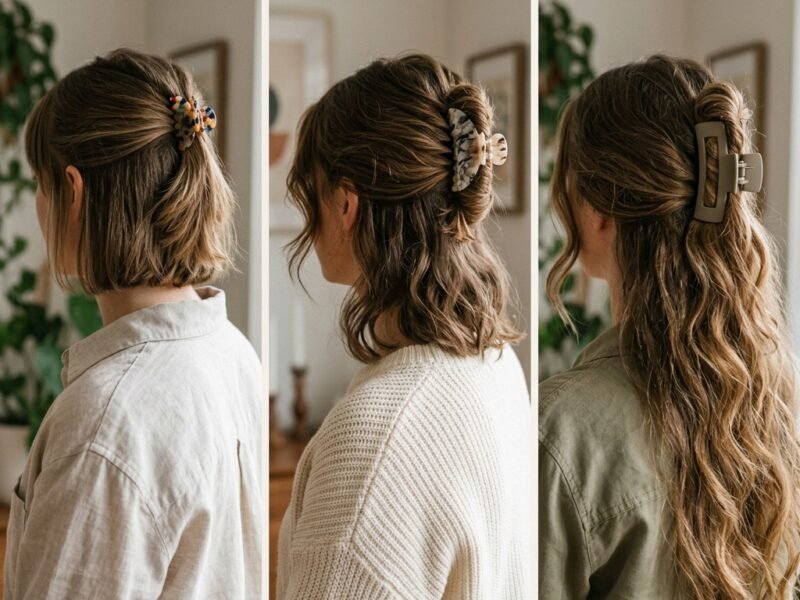
20. Claw Clip Twist
Fifteen seconds, and the fastest option on this list. Hair twists upward and the clip closes over the twist.
Clip size has to match the volume, and long thick hair defeats most standard clips outright. The twist is also the step people skip. Gathering and clipping flat gives the clip nothing to bite into, and it ends up on the floor by mid-morning.

21. Braided Ponytail
Braiding the length of a ponytail is the most practical thing to do with long hair on an active day. Nothing whips about and nothing tangles.
Braiding loosely rather than tightly keeps strain off the ponytail base, which already carries the full weight through one elastic. A small soft band at the end avoids the bulge a thick one creates.

22. Hollywood Glam Waves
Hollywood waves are set and pinned, never curled and released. Every section winds in the same direction, gets clipped flat while it cools, and comes down only at the end.
Long hair needs the pins more than short hair does, since the weight drops an unset wave within minutes. Brushing the cooled curls together with a soft bristle brush is what turns separate ringlets into one continuous S-shape.

23. Long Hair with Face-Framing Layers
Face-framing layers change the shape near the face without touching the overall length. That makes them the lowest-risk cut available to anyone growing hair out.
They also grow out invisibly, blending back into the length rather than passing through an awkward stage. For long hair that has become heavy and flat at the sides, this is usually the fix rather than a full layered cut.

24. Low Side Ponytail
Gathering low and to one side removes almost all the tension a high ponytail creates, which matters over a long day.
The hair sits forward over the shoulder, so it stays clear of a chair back and a coat collar. On very long hair this also stops the tail being sat on, which is a real and frequently overlooked annoyance.

25. Straight Hair with Hair Accessories
Clips and pins solve a specific long-hair problem. Sections refuse to sit flat, usually where a layer or an old fringe is growing out.
Pins pushed in against the direction the hair falls hold far better than pins pushed in with it. An odd number reads as deliberate placement where an even number reads as symmetry gone slightly wrong.

26. Voluminous Curly Hair
Long curls fight their own weight constantly. The curl pattern that springs up tightly at chin length hangs closer to a wave at waist length, simply because there is more mass pulling down.
Layers restore the bounce by removing that weight from the interior. Product applied to soaking wet hair and left undisturbed holds definition far better than product added later. Touching curls as they dry is what breaks the clump.

27. Twisted Half-Up Hairstyle
Two sections twist backward from the temples and meet at the crown. Simple, and it takes about ninety seconds.
Securing each twist with a small clear elastic before joining them stops both slipping, which they otherwise do within the hour on smooth long hair. Twisting away from the face rather than toward it keeps the sections lying flat.

28. Long Shag Hairstyle
The shag layers heavily throughout and lifts weight from the crown, which is precisely what long hair needs to avoid hanging flat.
It also grows out better than almost any other cut. The layers simply lengthen and the silhouette holds, which stretches salon appointments toward three months. Wavy hair carries it best, since the cut works with an existing pattern rather than imposing one.

29. Sleek Middle Part Hair
A centre part on long hair is unforgiving, since the line runs further and any drift becomes obvious. Running a comb tail back from the bridge of the nose finds the true midpoint.
Hair trained to a side part resists the change for several days. Combing it into position while damp and letting it dry there retrains it much faster than restyling dry.

30. Rope Braid Ponytail
Two sections twisted around each other form a rope. Long hair allows many more rotations than shorter hair, which gives the braid its spiral definition.
Direction is the trick everyone misses. Both sections twist the same way individually, then wrap around each other the opposite way. Twisting everything in one direction produces a rope that unwinds itself within minutes.

31. Long Hair with Soft Curls
Soft curls on long hair are a set rather than a style. They need cooling, then brushing out, to read as soft rather than defined.
Brushing feels wrong and is the necessary step. A soft bristle brush blends the curls into one another without destroying them. Left unbrushed, long curls look ringletted rather than relaxed, which is a different and much more formal look.

32. Elegant Low Bun
The low bun handles long hair’s weight better than any other updo, because the mass rests against the neck rather than pulling from the crown.
Very long hair produces a bun too bulky to sit neatly, so most people plait or rope the length first and then coil that. The braid compresses the volume and the finished bun looks deliberate rather than oversized.

33. Messy Side Braid
Sweeping everything over one shoulder makes this the easiest braid to do without a mirror, since the whole thing happens in front of the body.
Long hair benefits most from the widening step, and it should run from the tail upward. Working downward from the crown loosens the top and the braid comes apart before the ends gain any width.

34. Double Mini Buns
Two buns split the weight of long hair across two points instead of one. That makes them more secure than a single bun, despite looking less serious.
A true centre part matters, and parting by eye almost always drifts. Positioning both level with the top of the ears keeps the pair balanced; higher tips into costume, lower loses the shape.

35. Natural Flowing Long Hair
Worn loose, long hair depends entirely on the condition of the ends, since nothing distracts from them.
Those ends are the oldest hair on the head and have been through the most washing, brushing, and weather. Conditioner concentrated from the mid-lengths down, and a trim every three or four months, does more for this look than any styling product. Sleeping in a loose plait also cuts the friction that causes most overnight tangling.

Conclusion
Long hair offers the widest range of options and the least forgiveness in execution, because weight works against almost every style. These 35 stunning long hair hairstyles divide roughly into three groups. Fast options include the claw clip twist and the low side ponytail. Structured styles like the French twist and Hollywood waves need setting time. Cuts like the shag or face-framing layers change how everything else behaves.
Three adjustments carry across nearly all of them. Low placement beats high placement for comfort and security, since the weight rests rather than pulls. Anything gathered needs more pins and more elastics than the same style at shoulder length. And product belongs at the mid-lengths and ends rather than the roots, because that is where long hair is oldest and driest. Choosing styles that work with the weight rather than against it produces better results than any amount of extra hairspray.

Leave a Reply