

A rushed morning leaves almost no room for hair, and the styles that survive one have a specific quality in common: they work without full attention. Most of the options below take between thirty seconds and three minutes. What separates them is less about difficulty than about logistics — whether a mirror is needed, whether the style can be done while waiting for coffee, and whether it survives a commute with a coat collar or a car headrest pressing against it. This guide covers 27 easy hairstyles for busy mornings with the honest time cost attached to each. Several suit different hair lengths and textures, and a handful can be finished one-handed while doing something else.

1. Classic Low Ponytail
Roughly forty seconds, and no mirror required. Hair gathers at the nape, the elastic goes on, and a thin strand wraps over the band to hide it.
The low position sits under a coat collar without catching, which the high version does not. That makes it the practical winter choice. A drop of serum through the ends handles frizz, though the wrap alone does most of the work in making it look deliberate.

2. Messy High Bun
Under a minute once the motion becomes familiar. Hair goes up into a high ponytail, twists around itself, and secures loosely at the base.
Second-day hair performs better here than clean hair, which slides out. The one real drawback is positional: a high bun stops the head resting against a car headrest or a train seat. Anyone with a long commute usually shifts it slightly lower for that reason alone.

3. Half-Up Half-Down Twist
About ninety seconds. Two front sections twist backward and meet at the crown, held with a clip or a small elastic.
This one does need a mirror, since the meeting point sits where nobody can see it by feel. Twisting away from the face rather than toward it keeps both sections lying flat. Taking the sections from just above each ear gives the proportion that reads as balanced.

4. Sleek Straight Hair with Middle Part
Two to four minutes, and the only style here needing a heated tool. Running a flat iron through the front sections alone, rather than the whole head, cuts the time by two-thirds and covers the part of the hair anyone actually sees.
Hair trained to a side part resists a centre one for several days. Combing it into position while damp retrains it far faster than restyling dry.

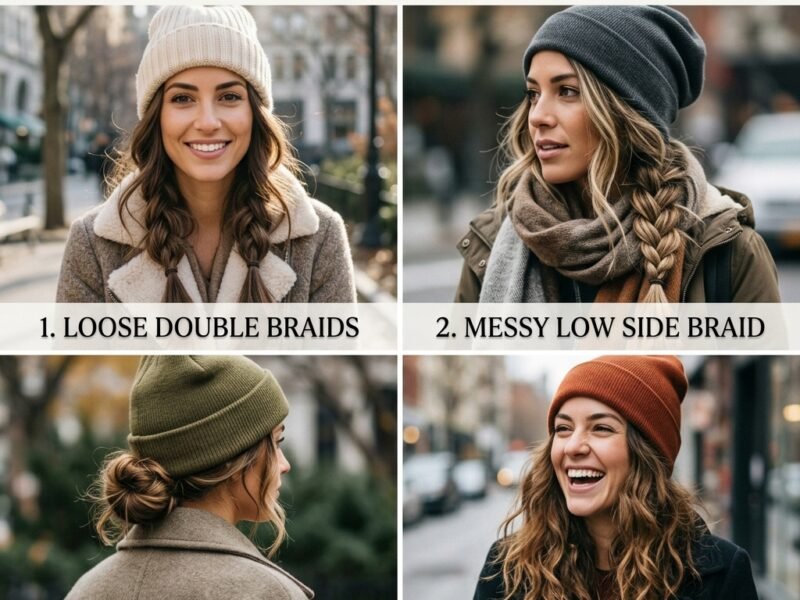
5. Simple Side Braid
Ninety seconds, entirely by feel, no mirror needed. Hair sweeps over one shoulder and braids down in three strands.
Working it forward over the shoulder is what makes it doable without seeing. A braid started at the back of the head is a different and much slower proposition. Pulling gently at the outer edges afterwards widens the shape, and starting that from the tail end upward stops the whole thing unravelling.

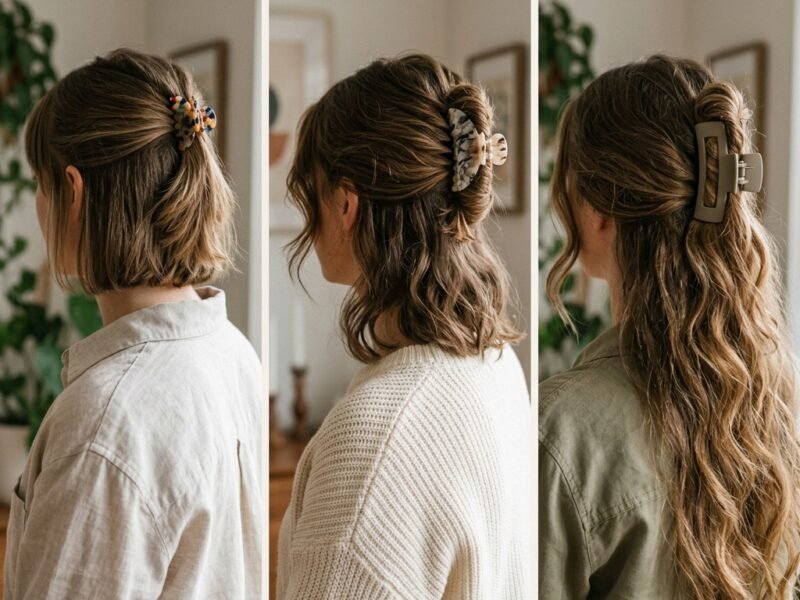
6. Quick Claw Clip Twist
Fifteen seconds. Nothing else on this list is faster.
Hair twists upward, the clip closes over the twist, and the ends fan out above it. The twist is the part people skip, and skipping it is why the clip slides down within the hour. Clip size also has to match hair volume — a small clip on thick hair has no chance, and a wide clip on fine hair finds nothing to grip.

7. Loose Beach Waves
Thirty seconds in the morning, provided the work happens the night before. Two loose braids on damp hair, undone after breakfast, produce a soft bend with no heat at all.
The wand version costs five to eight minutes and gives more control. Either way, humidity is the limiting factor, and waves styled on a damp day rarely hold past mid-morning. This guide to controlling frizz in humid weather covers what actually helps when the forecast is against the style.

8. Low Messy Bun
Forty-five seconds, and comfortable for a full day in a way the high version is not.
Hair gathers at the nape, twists into a loose bun, and holds with an elastic or two pins. The low placement means it sits flat against a headrest and slides under a hood or a coat collar without deforming. Second-day hair gives it the grip it needs.

9. High Sleek Ponytail
Two minutes with a brush, and the sharpest-looking option on this list.
Tension deserves genuine attention here. Neurologists at Michigan Medicine describe ponytail headache as an external traction headache: the hair shaft itself feels nothing, but the scalp holding the follicles carries a dense supply of pain-sensitive nerves, and pulling back on those follicles irritates them. Lack of sleep and stress both lower the threshold, which is precisely the state most rushed mornings begin in.
Two stacked elastics hold the height without needing to be pulled tight. Loosening the ponytail at lunchtime resets the pressure for the afternoon.

10. Simple Headband Style
Ten seconds, no skill involved, and it works on unwashed hair better than washed.
A padded or fabric band grips; a hard plastic one slides forward through the morning until it ends up somewhere near the forehead. Pushing the band on from the front and sliding it back an inch seats it more securely than dropping it straight down onto the crown.

11. Braided Ponytail
Two minutes, and the most durable option here for an active day. A ponytail braided down its length has nothing loose to tangle or whip about.
Braiding loosely rather than tightly keeps strain off the ponytail base, which is already carrying the elastic. The second elastic at the end should be small and soft, since a thick band creates a visible bulge.

12. Side Part Loose Hair
Five seconds. Moving the part is the smallest possible change that still reads as a different hairstyle.
A deep side part lifts the hair at the crown because the weight shifts across the head. The volume fades as the hair settles back toward its habitual line, so this works best on wash day when the part has not yet set.

13. Mini Front Braids
Under two minutes for a pair, and both can be done looking straight ahead rather than sideways into a mirror.
Two small braids run from the front hairline back, secured with clear elastics. Placement beats quantity: two positioned asymmetrically look considered, while six spread evenly look unfinished. They also handle a section of hair that refuses to sit flat.

14. Quick Top Knot
Thirty seconds, and it keeps hair entirely off the neck — worth knowing in summer, or for anyone who runs warm.
The knot sits highest of any style here, so it clashes with headrests, hoods, and helmets. Placing it slightly forward of the true crown also reduces the pull at the hairline over a long day.

15. Low Twisted Bun
Ninety seconds, and the most formal-looking thing achievable in that window.
Two sections twist around each other, then wrap into a bun at the nape. Pin angle decides whether it survives: pins pushed straight in slide out, while pins angled back against the twist grip properly. Three around the perimeter beat six crammed into the middle.

16. Bubble Ponytail
Three minutes, which makes it the slowest option here and better suited to a Friday than a Monday.
Elastics run down the length at intervals, and each section between them gets pulled outward. Even spacing is the whole job — uneven gaps produce mismatched bubbles that cannot be corrected afterwards. Fine hair needs the elastics placed closer together.

17. Loose Low Braid
A minute, entirely by feel, and one of the few styles that improves overnight rather than degrading. Slept in, it produces a soft wave for the following day.
Gathering at the nape and braiding loosely keeps tension low across the scalp. Pulling two pieces free at the temples afterwards softens the line where the hair pulls back.

18. Half Ponytail
Twenty seconds. The top section goes back into an elastic, the rest stays loose.
Where that top section is gathered from decides the result. Ear to ear gives a full shape; taking it from further forward leaves too little hanging and unbalances everything. This one also holds up well when hair needs to be tied back and released repeatedly through a day.

19. Curly Puff
Thirty seconds, and it asks nothing of the curl pattern beyond gathering it.
A fabric scrunchie compresses far less than a standard elastic, which matters at the gather point where curls flatten first. Fluffing the puff from underneath rather than the top restores volume without disturbing the definition on the surface. A light mist of water and leave-in revives day-old curls faster than adding fresh product.

20. Simple Hair Clip Style
Ten seconds, and the lowest-commitment change available.
A section twisted back and pinned with a decorative clip shifts a plain look without touching the rest of the hair. Clips grip better on unwashed hair, and placing one just behind the temple keeps it visible from the front, which is the entire point of a decorative clip.

21. Twisted Half Up Style
A minute and a half. Similar to the half-up twist but softer, since the sections come from further down the sides.
Natural waves suit it better than straight hair, where the twists tend to slip. Securing each twist with a small clear elastic before joining them stops that. Doing it in one motion usually means both sides loosen within the hour.

22. Low Side Ponytail
Fifteen seconds, done entirely by feel.
Hair gathers over one shoulder and secures low near the side of the neck. Because everything sits forward, the style stays clear of a chair back and a coat collar alike. It suits wavy hair better than poker-straight hair, which can look accidental rather than intentional in this position.

23. Straight Hair with Hair Pins
Twenty seconds. Two or three decorative pins placed on one side near the temple create an asymmetry that reads as deliberate styling.
Pins hold better when pushed in against the direction the hair falls. Sliding them in with the fall means they work loose through the morning. An odd number looks more considered than an even one, which is a small detail with a disproportionate effect.

24. Scarf Ponytail
Forty seconds including the tie. A scarf wrapped over the elastic adds colour without adding a styling step.
Silk slips and needs a double knot; cotton and grosgrain hold on the first. Tying the scarf over the elastic rather than instead of it means the ponytail survives even if the knot works loose during the day.

25. Quick French Twist
Two minutes, and the highest ratio of formality to effort on this list.
Hair gathers at the back, twists upward, and the ends tuck inside the fold. Pins go in horizontally through the seam of the twist, catching both sides — pushed in vertically they hold nothing. Slightly grippy hair makes the tuck hold, so this is another style that prefers day-old hair.

26. Double Mini Buns
A minute for the pair. A centre part divides the hair, and each side twists into a small bun.
Parting by eye drifts off centre almost every time. Running a comb tail straight back from the middle of the forehead gives a true line in three seconds. Positioning both buns level with the top of the ears keeps the look balanced.

27. Lazy Day Natural Hair
Fifteen seconds, and often the right answer.
A small amount of leave-in conditioner distributed through damp lengths supports whatever the hair does on its own. Applying it to soaking hair dilutes the product; applying it to fully dry hair leaves it sitting on the surface. Damp is the state that works, and that timing is the only real technique involved.

Conclusion
A rushed morning does not need a wide repertoire. Two or three reliable options, repeated until they happen automatically, beat a mental list of twenty-seven that each require thinking about. These 27 easy hairstyles for busy mornings divide fairly cleanly by time: the claw clip twist, headband, side part, and hair clips all land under twenty seconds, while the bubble ponytail and flat-ironed middle part sit at the far end.
Two patterns run through nearly all of them. Second-day hair holds a shape better than freshly washed hair, so the wash schedule matters more than the styling. And low-tension placement — low buns, loose braids, soft elastics — stays comfortable through a full day where a tightly pulled style rarely does. Choosing quick and simple hairstyles that suit the commute, the weather, and the state of the hair on that particular morning produces better results than working down a list in order.


Leave a Reply