

A hairstyle carries more visual weight than almost anything else in an outfit, and it is the one element that appears in every photograph from every angle. Most of the styles below take under ten minutes. The gap between a version that works and one that falls apart usually comes down to a single technique detail — where a section is gathered from, how clean the hair is, which direction a curl is wound. This guide covers 30 cute hairstyles that read as instantly stylish, with the pivot point identified for each one. Knowing what tends to go wrong is more useful than another description of what the finished look should resemble.

1. Effortless Messy Bun
The messy bun works on the principle that a slightly collapsed shape reads as deliberate. Hair gathers loosely at the crown, twists around itself, and secures without being smoothed flat.
Freshly washed hair defeats it. Clean strands have no grip, so the bun slides down within the hour and loses its height. Day-old hair holds the shape without any product at all, which makes this the natural choice for the morning after a wash rather than the morning of one.

2. Sleek High Ponytail
Height is what makes a high ponytail read as sharp rather than casual. Tipping the head forward while gathering brings everything to the crown, which is difficult to achieve looking straight into a mirror.
Two elastics stacked one over the other stop the classic failure — a heavy ponytail dropping two inches by lunchtime. Wrapping a thin section of hair around the base hides both. Brushing the surface with a boar bristle brush flattens flyaways more effectively than adding more product.

3. Soft Beach Waves
Beach waves are wound loosely, then brushed out so the curl relaxes into a bend rather than a spiral. Leaving the last inch of hair straight is what separates a beach wave from a ringlet.
Humidity is the enemy here, and the reason is structural. As a chemist writing for The Conversation explains, heat and water break the hydrogen bonds holding the protein rows in the hair’s cortex in position — and moisture in the air reforms them in a new arrangement, which is why a styled wave drops on a damp day. A flexible-hold spray slows the process; nothing stops it entirely.

4. Classic French Braid
A French braid adds hair to the outer strands as it travels down the head, which is what keeps it flat against the scalp. The most common error is picking up uneven amounts, producing a braid that widens and narrows unpredictably.
Taking roughly equal sections each time fixes it. Braiding on second-day hair also holds better than on freshly washed hair, and it stays neat through a workout or a long flight.

5. Half-Up Half-Down Twist
Two front sections twist backward and meet at the crown, held with a clip or a small elastic. The proportion matters more than the technique.
Taking too much from the front leaves too little hanging loose and unbalances the shape. Taking from just above the ear on each side gives the ratio most people are aiming for. Twisting away from the face rather than toward it also keeps the sections lying flat instead of standing away from the head.

6. Chic Low Bun
A low bun at the nape reads as formal in a way the high version does not, which is why it dominates offices and weddings. Smoothness is doing most of the work.
Pin placement decides whether it lasts. Pins pushed straight into the bun slide out; pins angled back against the direction of the twist grip properly. Three or four placed around the perimeter hold better than six crammed into the centre. This guide to professional bun hairstyles covers the office-appropriate variations in more depth.

7. Bubble Ponytail
Elastics run down the length of a ponytail at intervals, and each section between them gets pulled outward to form a rounded bubble.
Even spacing is the entire skill. Uneven gaps produce bubbles of different sizes, and no amount of adjusting afterwards corrects it. Fine hair needs the elastics placed closer together, otherwise each bubble looks thin rather than full.

8. Curtain Bangs with Loose Waves
Curtain bangs need directing while they dry, not after. Once they set in whatever direction they landed overnight, no amount of brushing redirects them without heat.
A round brush pulling each side outward and slightly back takes about thirty seconds. Curling the lengths away from the face rather than toward it keeps the waves from crowding the cheeks. The two techniques work together — bangs swept back, waves swept back, everything moving in one direction.

9. Braided Crown Hairstyle
Two braids travel along the sides of the head and wrap over the crown to form a continuous band. The look is intricate; the execution is not.
Length determines whether it works at all. Hair shorter than shoulder-length rarely reaches across, though a partial crown at the front achieves a similar effect. Pinning at four or five points around the head keeps the braid from drifting, which is what usually happens by the third hour of an event.

10. Textured Lob Hairstyle
The long bob sits between chin and shoulders, which happens to be the length where hair flicks outward against the shoulder. Internal layers break up that weight and stop the flick.
Texture spray at the mid-lengths rather than the roots gives the piecey finish the cut is designed around. Applied at the roots it flattens the shape instead. Anyone weighing this cut against other options will find upkeep intervals compared in this breakdown of 2026 hair trends.

11. Space Buns Hairstyle
A centre part divides the hair, each side becomes a ponytail, and each ponytail twists into a bun. Symmetry is the only real challenge.
Parting by eye almost always drifts off centre. Running a comb tail from the middle of the forehead straight back to the crown gives a true line. Placing the buns level with the top of the ears reads as deliberate; higher tips into costume territory, and lower loses the effect entirely.

12. Fishtail Braid
The fishtail uses two sections rather than three, crossing a thin piece from the outside of one over to the inside of the other. Slower than a standard braid, and no harder.
Piece thickness controls the entire look. Thin pieces produce the fine woven texture the braid is known for; thick pieces make it read as a rope twist. Loosening the edges afterwards adds width, which suits fine hair particularly well.

13. Sleek Middle Part Hair
The middle part demands precision, since a line even slightly off centre draws attention to itself. A comb tail run from the bridge of the nose backward finds the true midpoint.
Hair trained to a side part resists the change for a few days and will keep drifting back. Damp hair combed into position and left to dry retrains it faster than dry restyling does.

14. Romantic Loose Braid
This braid is deliberately imperfect. Weaving loosely from the start, then pulling gently at the outer edges, widens the whole shape and adds apparent volume.
The pulling happens from the bottom up. Starting at the top loosens the crown first, and the braid unravels before the ends are widened. Working upward from the tail keeps the tension intact where it matters.

15. High Messy Ponytail
Volume in a high ponytail comes from what happens after the elastic goes on, not before. Gently tugging small sections around the crown lifts the surface and creates height.
Too much tugging collapses the whole thing. Three or four small pulls is usually enough. Leaving two face-framing pieces loose at the temples softens the line where the hair pulls back, which is otherwise the harshest part of the style.

16. Layered Blowout Hair
A blowout depends on tension and the cool-down. A round brush holds each section away from the head while the dryer follows the brush down the length.
Releasing a section while it is still warm undoes the shape immediately. Hair holds whatever form it cools in, so pausing for a few seconds at the end of each section is the step that separates a full day of body from an hour of it. Directing the nozzle downward along the hair shaft also flattens the cuticle and adds shine.

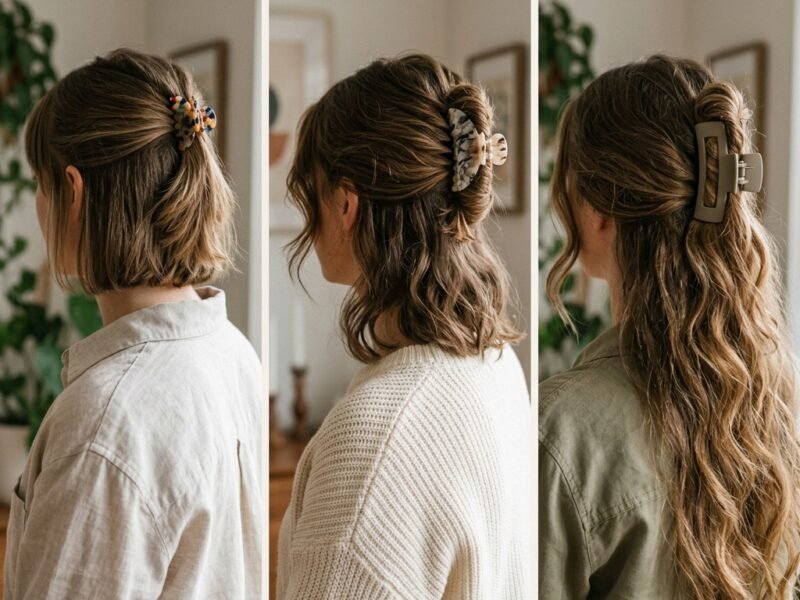
17. Claw Clip Updo
The claw clip has returned as a legitimate style rather than a convenience. Hair twists upward, the clip closes over the twist, and the ends fan out at the top.
Clip size has to match hair volume. A small clip on thick hair fails within minutes, and a large clip on fine hair has nothing to grip. Twisting the hair upward before clipping — rather than gathering and clipping flat — is what gives the hold. Most people skip the twist and then blame the clip.

18. Twisted Low Ponytail
Two sections from above the ears twist backward, then join the rest of the hair in a low ponytail. The twists cover the sides where a plain ponytail looks flat.
Securing the twists with a small clear elastic before adding the main ponytail keeps them from loosening. Doing everything in one motion usually means the twists slip within the hour.

19. Waterfall Braid
The waterfall drops one strand at each pass and picks up a fresh one from above, which creates the cascading effect running horizontally across the head.
Dropped strands need to fall cleanly rather than tangle into the braid below. Curling the lengths before braiding, not after, keeps them separated and makes the cascade visible. Braiding first and curling afterwards flattens the whole effect.

20. Soft Vintage Waves
Vintage waves are set and then brushed, never curled and left. Every section winds in the same direction, gets pinned flat while it cools, and only comes down at the end.
Brushing is the step people avoid, and skipping it leaves separate ringlets rather than a continuous S-shape. A soft bristle brush blends the curls into one another without destroying them. Setting an hour ahead and brushing just before leaving gives the cleanest result.

21. Boho Side Braid
A side braid sits over one shoulder with the texture kept deliberately soft. Pulling out small pieces near the face adds the lived-in quality the style depends on.
Hair that is too clean slides out of a loose braid quickly. A light mist of texture spray beforehand supplies grip. Accessories — small flowers, beads, thin ribbon — go in as the braid is worked, not pinned on afterwards, which is what makes them sit flush.

22. Voluminous Curly Ponytail
Curls gathered into a ponytail lose definition at the point where the elastic grips, which is the recurring complaint about this style.
A soft fabric scrunchie compresses less than a standard elastic and keeps the curls at the gather point intact. Fluffing the ponytail from underneath rather than the top restores volume without disturbing the curl pattern on the surface. Refreshing with a water and leave-in mix beats reapplying styling product to dry curls.

23. Braided Ponytail
A ponytail braided down its length holds far better through activity than a loose one. Nothing whips around, and nothing tangles.
Braiding slightly loosely rather than tightly keeps tension off the ponytail base, where the hair is already under strain from the elastic. A second elastic at the end should be small and soft — a thick band creates a bulge that shows in profile.

24. Hollywood Glam Waves
The Hollywood wave is larger and more sculpted than its vintage cousin, with a deep side part and one wave sweeping across the forehead.
Barrel size drives the scale. A wide barrel produces the sweeping curve; a narrow one produces something closer to a finger wave. Pin-setting each wave while it cools is not optional at this size, since the weight of the hair drops an unset wave within minutes.

25. Mini Braids Hairstyle
Small braids scattered through loose hair add detail without changing the overall shape. They suit festivals, and they also disguise a section that refuses to sit properly.
Placement beats quantity. Two or three braids positioned asymmetrically look intentional; a dozen spread evenly look like an unfinished project. Clear elastics disappear at the ends far better than coloured ones.

26. Sleek Low Ponytail
Gathered low, brushed flat, finished with a strand wrapped over the elastic. Under two minutes from start to finish.
A wet-look gel gives the sharpest version, though it sets hard and cannot be adjusted afterwards. A smoothing cream stays flexible and suits anyone who wants to loosen the style later in the day. Switching the gather point between wears spreads the tension rather than loading the same spot daily.

27. Feathered Layer Hairstyle
Feathered layers angle backward away from the face, which is what produces the light, open shape. The cut only reads correctly when the layers are styled in that direction.
Blow-drying the front sections back with a round brush is essentially mandatory. Left to dry flat, feathered layers lose their entire point and simply look uneven.

28. Ribbon Ponytail
A ribbon tied over the elastic changes a plain ponytail into something deliberate for the cost of ten seconds.
Grosgrain and velvet hold a knot; satin slips loose repeatedly. Tying the ribbon over the elastic rather than in place of it means the ponytail holds even when the bow sags. Width scales with hair volume — a narrow ribbon vanishes against thick hair.

29. Double Dutch Braids
Dutch braids cross the outer strands underneath rather than over, which pushes the braid outward from the scalp. That single reversal is the whole difference from a French braid.
Two braids need a clean centre part to look right, and the part has to run the full length to the nape. Stopping halfway leaves a muddled section at the back. The style holds through exercise and travel better than almost anything else here.

30. Elegant Wedding Updo
A formal updo is built rather than gathered. Sections get pinned individually, and the shape emerges from how they sit against one another.
This is the one style on the list worth a practice run. Booking a trial, or attempting it once on an ordinary evening, reveals whether the hair holds the shape at all. Discovering otherwise on the morning of an event leaves no time to change course. Hair washed the previous day holds pins far better than hair washed that morning.

Conclusion
Most of these styles share the same two requirements: hair with a little grip, and one technique detail executed correctly. Second-day hair outperforms freshly washed hair for nearly every bun, braid, and textured look on this list, which is worth knowing before reaching for the shampoo.
The rest is practice. A style attempted once on a quiet evening takes half the time on the second try and a quarter by the fifth. Picking two or three from these 30 cute hairstyles and repeating them until they become automatic produces better results than working through the whole list once.



Leave a Reply