
Some mornings call for a hairstyle that looks considered without requiring a full styling routine. A braid can do exactly that. It keeps hair organised, works with a wide range of outfits, and can look just as appropriate with a tailored blazer as it does with a soft knit and trousers.
The trick is choosing a braid that suits the working day ahead. A simple three-strand plait feels relaxed and practical, while a low braided bun creates a cleaner silhouette for presentations or formal meetings. A narrow braid tucked into a ponytail adds detail without making the hairstyle look complicated.
These braided hairstyles for work focus on realistic five-minute routines, with simple instructions, clear visual differences, and variations for different hair lengths and textures. Most require only a brush, a small elastic, and a few bobby pins. The timings are practical estimates for hair that is already detangled, rather than guarantees for every hair type or skill level.
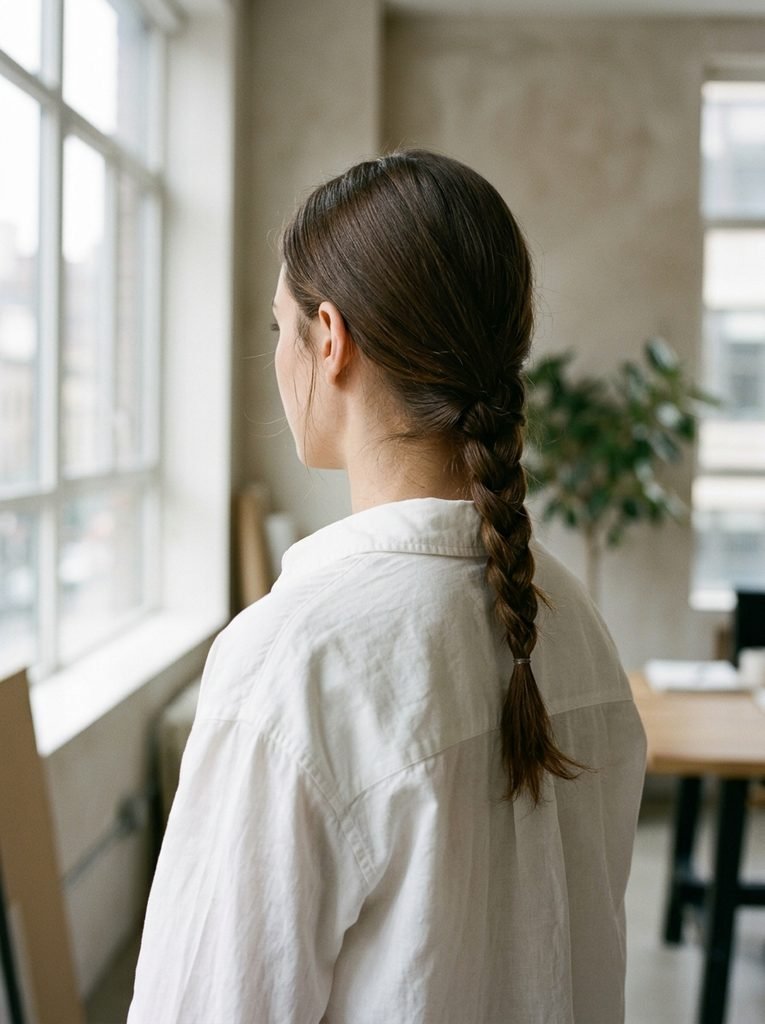
The Low Nape Braid for a Clean, Professional Finish
The low nape braid is a useful starting point for anyone who wants a tidy hairstyle without a complicated technique. It sits close to the back of the head, begins just below the ears, and follows a straight line down the length. The overall effect is understated, making it easy to pair with workwear in neutral colours, structured jackets, or simple dresses.
Unlike a high ponytail, this braid does not create much height at the crown. That makes it particularly suitable for days when a smooth, restrained silhouette feels more appropriate than a voluminous style.
How to create the look in five minutes
- Brush the hair gently to remove tangles and decide where you want the parting.
- Gather the hair at the nape of the neck without pulling the roots uncomfortably tight.
- Divide the length into three reasonably even sections.
- Cross the right section over the middle, then the left section over the new middle section. Repeat until you reach the ends.
- Secure the braid with a small elastic and smooth any obvious flyaways with your fingertips.
For a slightly more polished appearance, take a narrow strand from the tail, wrap it around the elastic, and tuck the end underneath with a bobby pin. This small finishing detail makes the hairstyle look more deliberate. Best suited to: Medium-length and long hair, particularly straight or gently wavy textures. Workwear pairing: A crisp shirt, tailored trousers, a fine-knit sweater, or a simple collared dress.
The Side Braid for Busy Commutes and Everyday Office Wear
A side braid offers a different look without adding much work. Instead of braiding behind the body, bring the hair over one shoulder and work where both hands can move comfortably. The result is easier to check in a mirror and gives the braid a visible place beside the face. This style works particularly well with casual office outfits and business-casual dress codes. Its softer shape balances structured clothing, while the braid keeps the length from falling across the desk, keyboard, or shoulders throughout the day.
The finish can be sleek or relaxed. A tighter plait creates a more defined line, while gently widening the finished braid gives it a softer appearance.
A quick side-braiding method
Start by brushing the hair and making a centre or side part, depending on your usual style. Sweep the length over one shoulder, then divide it into three sections. Braid down to the ends and secure with an elastic. For a little more shape, hold the finished braid near the elastic and gently loosen a few outer loops with your fingertips. Work gradually from the bottom upward rather than pulling every section at once. This helps maintain the braid’s overall structure.
If short layers escape around the face, leave them alone if they look intentional, or secure the pieces that interfere with your work using two small pins. Best suited to: Medium and long hair, including hair with light layers. Workwear pairing: A blazer over a fine-knit top, a button-down shirt, or a simple monochrome outfit.

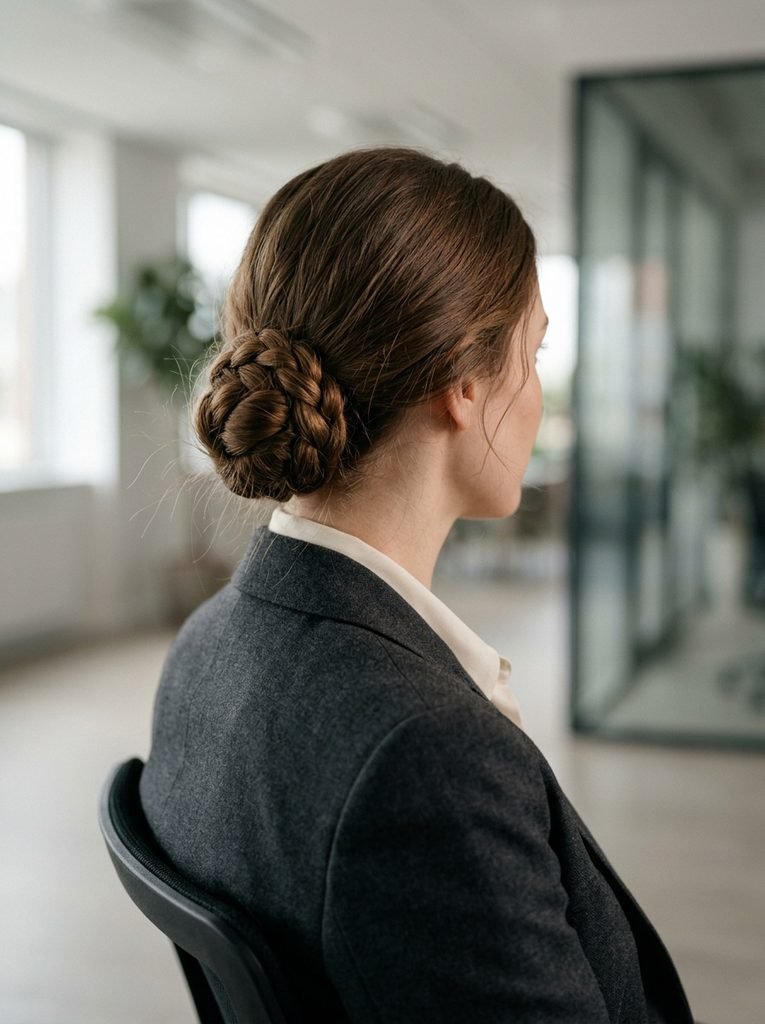
The Braided Low Bun for Meetings and Formal Office Days
Some workdays call for a hairstyle that stays compact and keeps the entire length off the shoulders. A braided low bun is a practical option for presentations, interviews, conferences, or meetings where a more structured appearance feels right.
The braid adds texture to an otherwise simple bun. From the front, the hairstyle can look smooth and understated. From behind, the woven pattern creates enough detail to make the finish interesting without needing decorative clips or elaborate accessories.
Although a long, thick braid may take longer to wrap, a slim braid can be pinned into a small bun surprisingly quickly. The five-minute version works best when the hair is already detangled and the pins are within reach.
How to make a braided bun quickly
Gather the hair into a low ponytail and secure it with a comfortable elastic. Braid the ponytail using three sections, then fasten the end with a second small elastic.
Next, wrap the braid around the original ponytail base. Tuck the tip underneath the coil and place bobby pins around the bun to hold it in position. Crossed pins can help anchor the shape when the hair is slippery.
Keep the bun relatively small rather than forcing the entire length into a large coil. If the hair is especially long, wrapping the braid more loosely around the base may be easier.
For a clean finish, smooth the hair along the parting and check the bun from the side. There is no need to flatten every natural strand; the aim is a secure shape rather than a completely rigid one.
Best suited to: Medium-long and long hair that can be gathered into a ponytail.
Workwear pairing: A fitted blazer, a collared shirt, a high-neck blouse, or a structured dress.
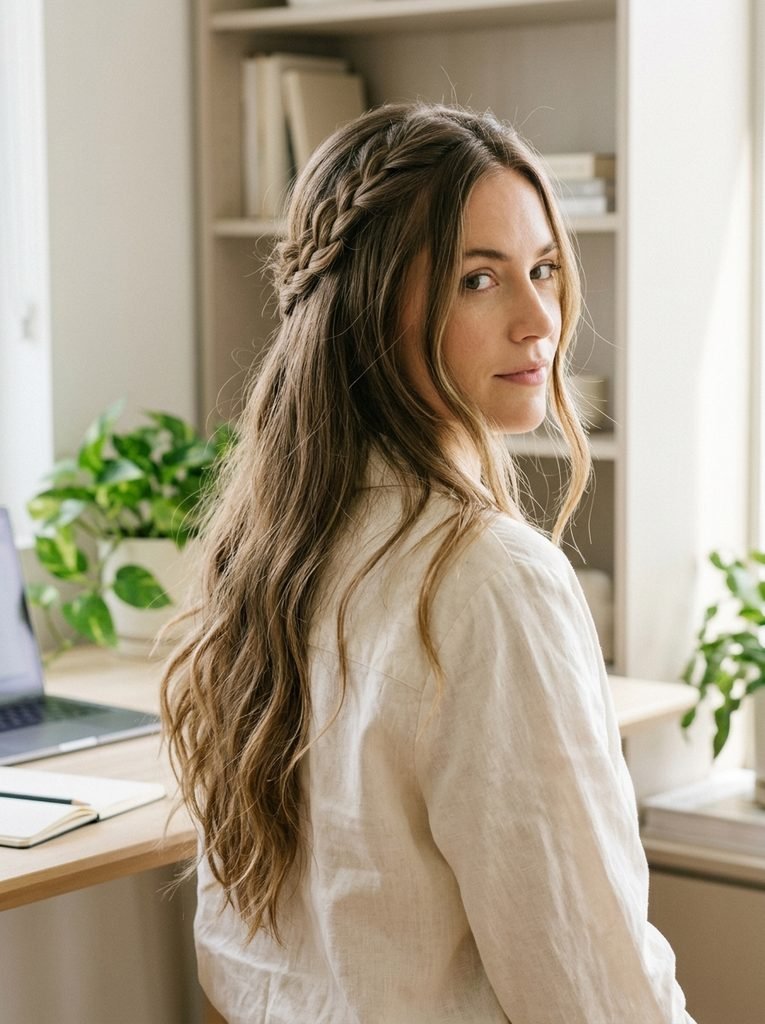
The Half-Up Braid for Hair That Looks Better Left Down
Not every professional hairstyle needs to pull all the hair away from the face. A half-up braid offers a middle ground: the front sections stay controlled while the remaining length falls naturally over the shoulders.
This is a good choice for people who enjoy wearing their hair down but dislike repeatedly tucking it behind their ears during the working day. It also adds a little visual interest to a simple blouse without requiring a full updo.
The braid itself can be very small. In fact, a narrow plait often looks more balanced when the remaining hair is loose, particularly if the lengths have natural waves or soft layers.
Create the half-up look
Take a section of hair from each temple and bring both sections towards the back of the head. You can braid one section before joining the two, or make a single small braid from the combined top section.
For the quickest version, gather a modest section from either side, braid it loosely, and secure it with a small elastic at the back. Alternatively, braid the two side sections separately and fasten them together with a discreet pin.
Keep the remaining hair in its natural texture. If the ends look untidy, a quick brush through the lengths is usually enough. There is no need to curl the entire head simply to finish a small braid.
Those with shorter layers can leave a little hair around the face, provided it does not fall into the eyes while working.
Best suited to: Medium-length and long hair, including soft waves and layered cuts.
Workwear pairing: A fine-knit cardigan, a simple blouse, a fitted T-shirt under a blazer, or a shirt dress.
The Braided Ponytail for a Sleek, Practical Finish
A braided ponytail combines two familiar hairstyles into one practical option. The ponytail keeps the hair away from the face, while the braid prevents the length from swinging freely throughout the day.
The placement changes the character of the style. A high ponytail feels more energetic, a mid-height version looks balanced, and a low ponytail creates a quieter, more understated finish. For a traditional office setting, a mid-height or low placement is often an easy starting point.
This style also makes sense for longer hair that tends to tangle against coat collars or chair backs. Braiding the length keeps the strands grouped together, which can make the hairstyle easier to manage during a busy schedule.
The five-minute method
Brush the hair and gather it into a ponytail at your preferred height. Secure the base with an elastic, then divide the hanging length into three sections and braid to the ends. Fasten the finished plait with another elastic.
If you want the base to look more polished, wrap a thin strand of hair around the first elastic before braiding. Pin the strand underneath the ponytail so it stays out of sight.
A smooth ponytail base gives the style a sharper appearance, while a little natural texture at the crown makes it feel less formal. Choose whichever finish works with the rest of your outfit.
Avoid pulling the base so tightly that it feels uncomfortable. A hairstyle that causes tension is unlikely to feel pleasant throughout a long workday.
Best suited to: Medium-long and long hair.
Workwear pairing: A crisp shirt, a blazer and trousers, a simple knit dress, or a coordinated neutral outfit.
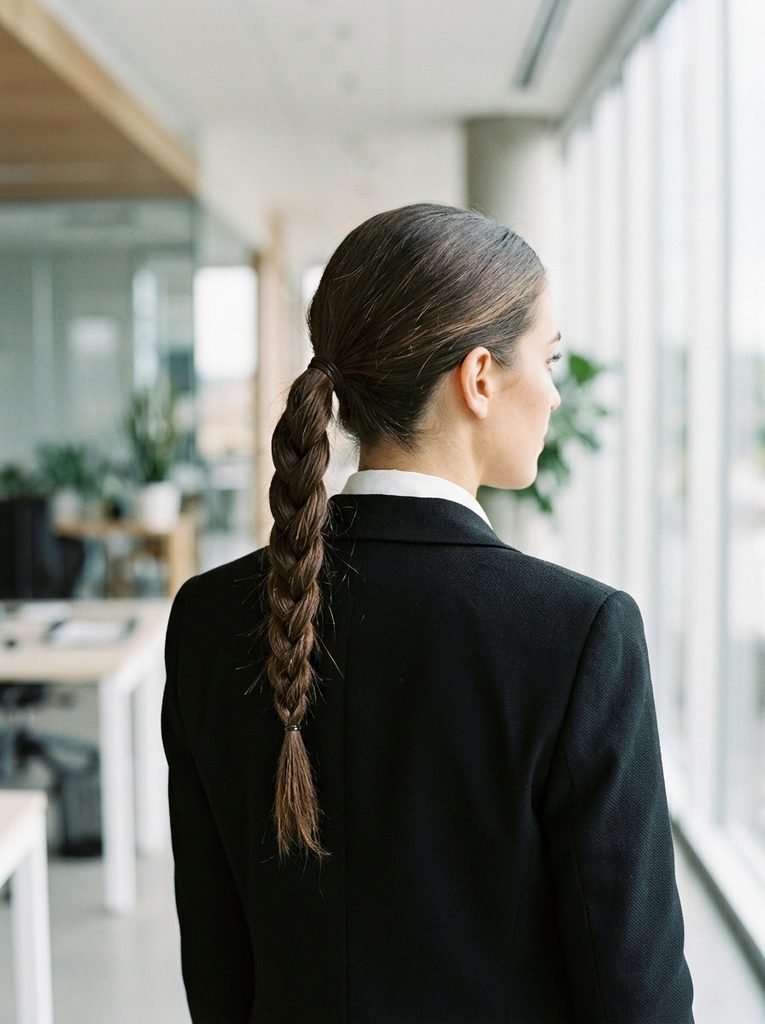
The French Braid for a Tidy, Close-to-the-Head Style
A French braid creates a different silhouette from a standard plait because sections of hair are gradually incorporated as the braid moves down the head. Instead of beginning with all the hair gathered together, the woven pattern starts near the crown and stays close to the scalp.
The finished look is tidy and secure, making it useful for long commutes, busy office days, and situations where loose lengths become distracting. It also works well with collared shirts because the braid follows the head rather than creating a bulky shape at the nape.
The main consideration is technique. A French braid takes more coordination than a simple side braid, so five minutes is a realistic target after the movement becomes familiar, not necessarily the first time you try it.
A simplified French-braid routine
Begin with a small section of hair at the crown and divide it into three strands. Start a regular braid by crossing the side sections over the middle.
Before each new crossover, add a small amount of loose hair to the section you are about to move. Continue adding hair from alternating sides as you work down towards the nape.
Once all the loose hair has been incorporated, finish with a regular three-strand braid and secure the end with an elastic.
The key to a neat result is taking similarly sized sections from each side. Very large additions can make the braid look uneven, while tiny sections increase the time needed to finish it.
If you are short on time, a French braid that begins just below the crown can be easier than starting close to the hairline.
Best suited to: Medium-long and long hair with enough length to incorporate into the braid.
Workwear pairing: A collared blouse, a structured jacket, a simple knit, or a work dress with a clean neckline.
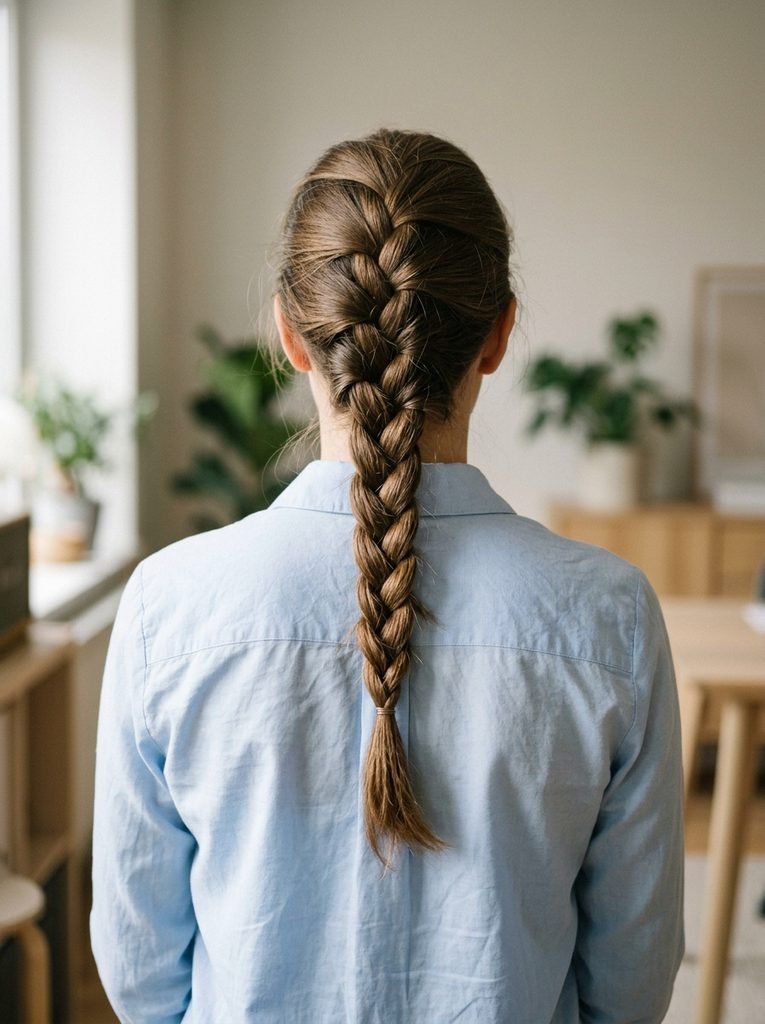
The Small Accent Braid for Shorter Hair
Shorter hair can be braided for work, too. Instead of trying to gather every strand into a full plait, use a small braid as a detail along one side of the head.
This approach is especially useful for bobs and shoulder-length cuts that cannot comfortably form a ponytail. The rest of the hair stays down, so the haircut remains visible, while the braided section keeps one side away from the face.
The look is subtle enough for everyday office wear. It adds texture without competing with statement earrings, a patterned blouse, or a structured jacket.
How to style a side accent braid
Create your usual parting and take a narrow section near the temple. Divide it into three strands and braid towards the ear, keeping the plait small and relatively close to the head.
Secure the end with a tiny elastic or slide a discreet bobby pin underneath the surrounding hair. Tuck the braid behind the ear if the length allows, or pin it just above the ear for a visible detail.
For a more understated finish, use a pin that matches your hair colour. A small metallic clip can work as well if your workplace dress code allows accessories.
Short layers may escape from the braid, especially around the hairline. A small amount of lightweight styling product can help manage these strands, but heavy creams are unnecessary for such a small section.
Best suited to: Bobs, shoulder-length cuts, and shorter layered hairstyles.
Workwear pairing: A crew-neck top, a tailored blouse, small earrings, or a minimalist jacket.
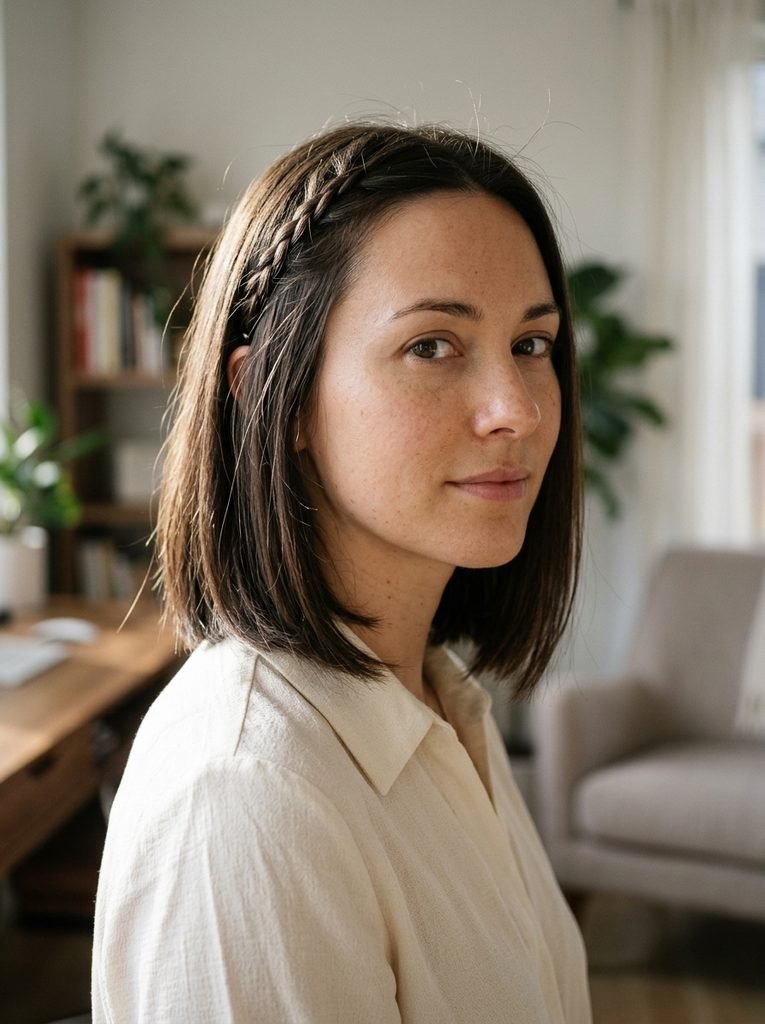
The Double Side Braids for a Long, Active Day
Two simple braids offer a practical alternative when a single plait feels too heavy or when you want the hair divided evenly on both sides. The style has a more casual character than a low bun, but it can still work in relaxed offices and creative workplaces.
The symmetrical shape looks particularly good with a clean centre parting and simple clothing. It is also useful for active workdays when you are moving between desks, travelling, or spending time outdoors.
The important distinction is how tightly and precisely the braids are finished. Neat sections and discreet elastics make the hairstyle feel intentional, while loose, uneven braids can look more suited to a weekend outfit.
A straightforward double-braid routine
Part the hair down the centre and separate it into two sections. Work on one side at a time, starting near the nape or slightly higher if you prefer more length around the face.
Divide the first section into three strands and braid to the ends. Secure it with an elastic, then repeat on the opposite side.
Check that both braids sit at a similar height. They do not need to be perfectly identical, but keeping the starting points balanced gives the style a more finished appearance.
For a softer result, gently loosen a few sections near the lower half of each braid. If you prefer a sharper look, leave the braids compact and smooth the parting with a comb.
Best suited to: Medium-long and long hair.
Workwear pairing: A fine-knit top, a plain button-down shirt, straight-leg trousers, or a simple casual dress.
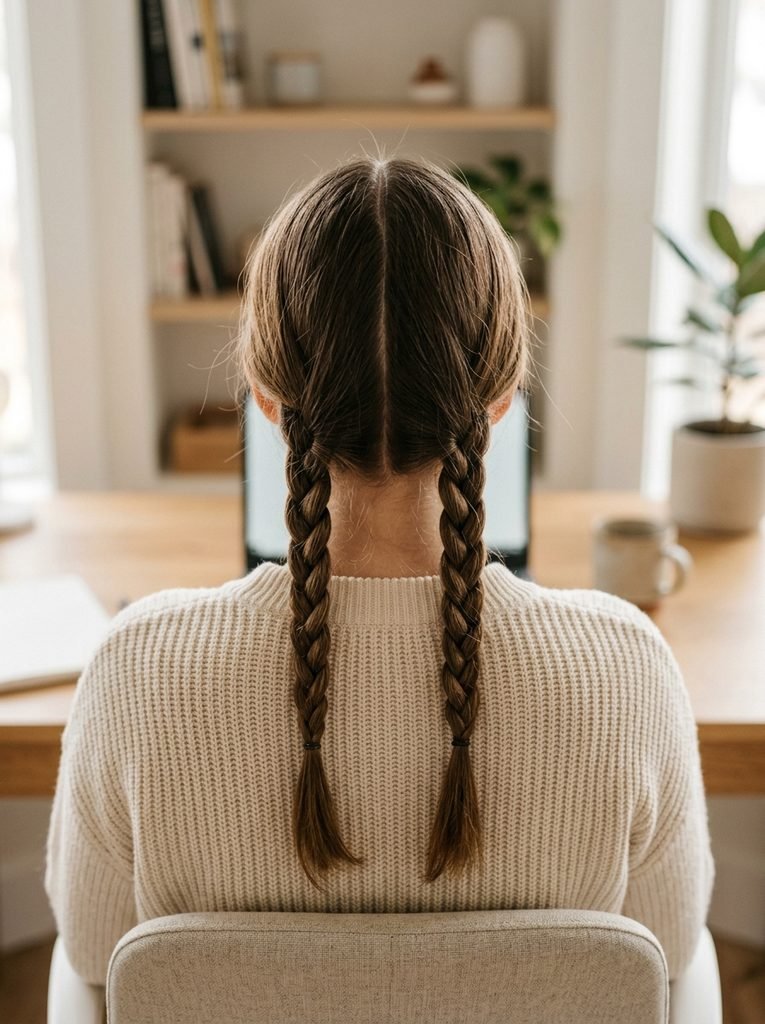
The Braided Headband for Hair Worn Down
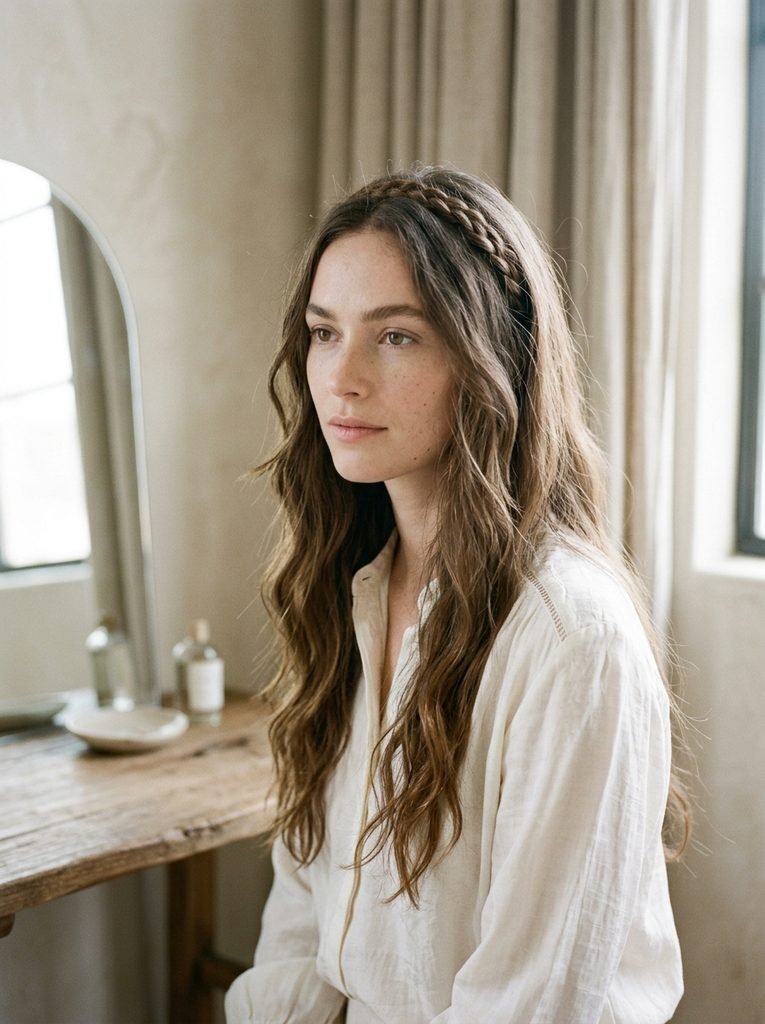
A braided headband keeps the front of the hair away from the face while leaving the lengths loose. It offers a more decorative finish than a standard half-up braid, but the result can remain subtle when the plait is narrow.
This style works best when you want the movement of loose hair without constantly brushing it away from your eyes. It pairs particularly well with simple clothing because the braid provides the main visual detail.
The classic version involves braiding a section from one side of the head and bringing it across the crown. However, a full braid that travels from one ear to the other can take longer than five minutes, especially on thick or layered hair. For a quick workday version, a smaller braided section pinned across the top is more realistic.
The quick headband variation
Take a narrow section from just behind one ear and braid it towards the ends. Bring the braid across the top of the head and secure it behind the opposite ear with a bobby pin.
Position the braid far enough back that it does not sit directly across the forehead. This keeps the front of the hairstyle looking natural and makes the braid feel more like a headband than a fringe.
Leave the remaining hair in its usual texture. A quick brush through the lengths or a light refresh of natural waves completes the look.
If your hair is too short for a braid to reach across the crown, pin a small accent braid near one temple instead. It creates a similar effect without requiring extra length.
Best suited to: Medium-long and long hair, especially hair worn down with natural waves.
Workwear pairing: A plain blouse, a lightweight cardigan, or a simple dress with minimal accessories.
The Loose Dutch Braid for a More Defined Plait
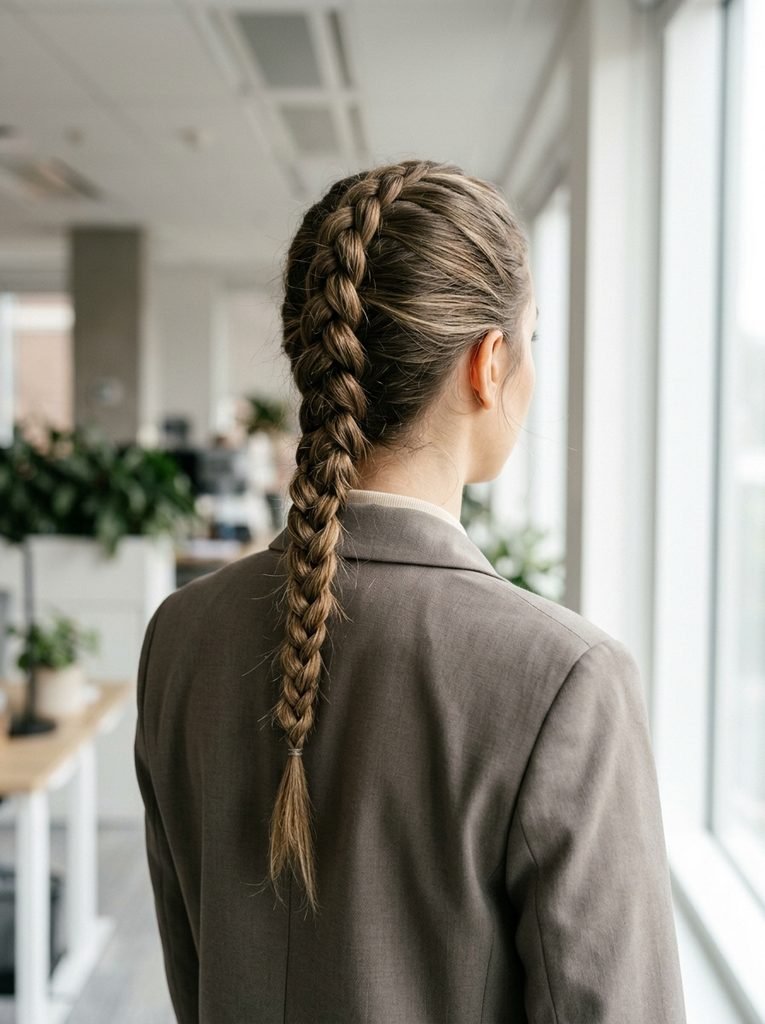
A Dutch braid resembles a French braid, but the sections cross underneath the middle strand rather than over it. This creates a more raised, visible pattern along the head.
For work, the difference is mainly visual. A French braid tends to sit flatter, while a Dutch braid has a more pronounced woven appearance. The latter can add definition to hair that otherwise looks quite simple when gathered at the back.
A single Dutch braid is suitable for creative offices, casual business settings, or days when you want the hairstyle to have a little more character without adding accessories.
The technique requires practice, so beginners may need more than five minutes. Once the movements become familiar, however, the routine can be shortened considerably.
How to get the raised braid effect
Start with three sections near the crown. Cross the right section underneath the middle, then cross the left section underneath the new middle.
Add a little loose hair to each side section before crossing it underneath again. Continue down the head until all the hair has been incorporated, then finish the remaining length with a regular braid.
Secure the end and check the raised pattern from behind. If you want a softer finish, ease a few outer loops apart with your fingertips. Avoid pulling so much that the braid loses its definition.
For an office-ready look, a single braid down the back is often easier to style with structured clothing than two raised braids on either side.
Best suited to: Medium-long and long hair, with enough length to gather into the braid.
Workwear pairing: A neutral blazer, a simple blouse, or a fine-knit top.
Choosing the Right Braid for Your Workday
The best option depends on how much time you have, how you like to wear your hair, and the kind of day ahead. A braid that works for a relaxed office may not be the most convenient choice for a formal meeting.
| Hairstyle | Approximate time | Overall finish | Best use |
|---|---|---|---|
| Low nape braid | 2 to 4 minutes | Smooth and understated | Everyday office wear |
| Side braid | 2 to 3 minutes | Soft and relaxed | Commuting and business casual |
| Braided low bun | 3 to 5 minutes | Compact and polished | Meetings and presentations |
| Half-up braid | 2 to 4 minutes | Light and feminine | Hair worn down |
| Braided ponytail | 2 to 4 minutes | Structured and practical | Busy working days |
| French braid | 3 to 5 minutes with practice | Close and tidy | Longer days |
| Side accent braid | 1 to 3 minutes | Subtle and minimal | Bobs and shorter cuts |
| Double side braids | 3 to 5 minutes | Symmetrical and casual | Relaxed workplaces |
| Braided headband | 3 to 5 minutes for a simple version | Decorative but understated | Loose hair |
| Dutch braid | 3 to 5 minutes with practice | Defined and textured | Creative business settings |
These times assume the hair is already detangled and that the technique is familiar. Thick hair, very long lengths, intricate layering, or first attempts may require additional time.
Which braid works best for your hair texture?
Straight hair often gives a clean, defined braid, but very smooth strands can slip while being crossed. A lightweight texturizing product may help the sections stay in place. Start with a small amount to avoid making the hair stiff.
Wavy hair naturally adds texture to a braid. A side braid or relaxed low plait can work particularly well when the goal is a softer finish. Brush gently before styling if the lengths are tangled, rather than trying to force every strand into a perfectly smooth shape.
Curly and coily hair can be braided in the same basic patterns, although sectioning and preparation may differ. Work with the hair’s natural texture, detangle gently using a suitable method, and avoid pulling the roots too tightly. A low braid, a compact bun, or a braided ponytail can be adapted to the amount of length available.
Fine hair may look more delicate in a narrow braid. A small amount of widening after braiding can create a fuller visual effect, while two small braids or a half-up style can add detail without requiring a large amount of hair in one section.
For more ideas specifically suited to finer strands, see Soreva Style’s guide to braided hairstyles for thin hair.
Short hair has its own practical limits. If the lengths do not reach the nape, a side accent braid or a small half-up braid is generally more realistic than a full-length plait. You can also explore these short hair styling ideas for alternatives that work with a shorter cut.
Small Details That Make a Work Braid Look Finished
A braid does not need to be elaborate to look tidy. In many cases, the finish depends on three small details: the parting, the elastic, and the amount of tension used.
Start with a parting that suits the hairstyle. A centre part creates a balanced appearance for double braids, while a side part can make a low braid or half-up style feel softer. There is no need to change your usual parting if it already works well with your haircut.
Next, choose an elastic that blends with your hair or use a small decorative tie that suits your workplace. A visible elastic is perfectly acceptable, but wrapping a narrow strand of hair around the base creates a cleaner finish when you have an extra half-minute.
Finally, keep the braid secure without making it uncomfortable. A little looseness through the length can look attractive, but the base should hold the hairstyle in place. If you notice pulling, tenderness, or a headache, loosen the braid and secure it again more gently.
Accessories are optional. A simple metal clip or a small neutral barrette can complement an understated outfit, while multiple decorative pieces may distract from the clean lines of a professional look.
How to Make a Five-Minute Morning Routine Easier
The easiest way to save time is to decide on the hairstyle before the morning begins. Keep a brush, two or three elastics, and a couple of bobby pins together near the mirror. This avoids searching through drawers halfway through styling.
It also helps to have one dependable backup. If a French braid is taking too long, switch to a side braid or braided ponytail rather than repeatedly starting over. The simpler option can still look neat with a well-positioned parting and a secure elastic.
Hair that is already detangled will be easier to section. If you normally wash your hair in the evening, gently arranging it before bed may reduce the amount of work required the next morning. Avoid going to sleep with hair soaking wet or tightly pulled into a braid.
For additional quick options on days when you do not feel like braiding, browse Soreva Style’s guide to easy hairstyles that take only minutes.
The aim is not to make every workday hairstyle look identical. It is to have a few reliable choices that suit different outfits, schedules, and hair textures.
Frequently Asked Questions
What is the easiest braid for work?
A classic side braid or low nape braid is usually the simplest starting point. Both use the basic three-strand technique and need little more than an elastic to finish.
Can I create a professional braid in five minutes?
Yes, a simple braid is often achievable within five minutes once you are familiar with the technique. More intricate styles, such as French and Dutch braids, may take longer while you are learning.
Which braided hairstyle works best for a formal office?
A low braided bun, a smooth braided ponytail, or a neat French braid can suit a more formal office environment. The best choice depends on your workplace dress code and personal preference.
Can I braid short hair for work?
Yes. A slim accent braid near the temple, a small half-up braid, or a braid tucked behind one ear can work with a bob or shoulder-length haircut. Use a discreet pin to secure shorter pieces.
How can I keep a braid neat throughout the day?
Begin with detangled hair, use an elastic that holds without snagging, and secure loose sections with a few discreet pins if needed. Avoid excessive tension, and keep a spare elastic in your bag for quick adjustments.
Are braids suitable for fine or thin hair?
Yes. Narrow plaits, side braids, and half-up braids can work well on finer hair. Gently widening the finished braid may create a fuller appearance, but avoid pulling the sections apart so much that the style becomes loose.
A Simple Braid Can Be Enough
A work hairstyle does not need elaborate twists or a collection of styling products to look put together. A neat plait, a secure elastic, and a little attention to the finishing details can be enough for an ordinary office morning.
Start with the low nape braid or side braid if you want the easiest routine. Try a braided bun when you need the hair completely off your shoulders, or choose a small accent braid if you prefer to wear your hair down.
Once two or three techniques become familiar, switching between them takes very little thought. That is what makes braided hairstyles useful for work: they offer variety without requiring an entirely new morning routine.


Leave a Reply